About Pterostylis curta R.Br.
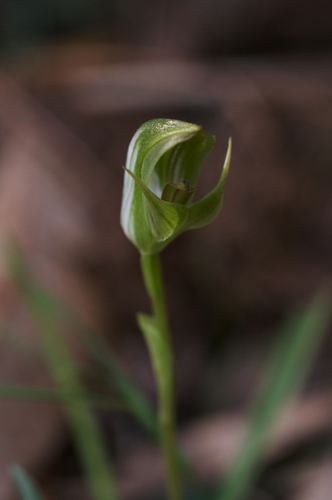
Pterostylis curta R.Br., commonly known as the blunt greenhood, produces a rosette of between two and six leaves. Each leaf is dark green, egg-shaped to elliptic, 20–100 mm (0.8–4 in) long and 10–30 mm (0.4–1 in) wide, with a distinct petiole and sometimes a wavy edge. A single forward-leaning white and green flower with a brown tip is borne on a 100–300 mm (4–10 in) high flowering spike. The flower measures 28–35 mm (1.1–1.4 in) long and 11–15 mm (0.4–0.6 in) wide. The dorsal sepal and petals are fused to form a hood called a "galea" that covers the column; these structures are similar in length and end in a blunt tip. A wide gap sits on each side of the flower between the petals and lateral sepals. The lateral sepals are erect, roughly the same length as the galea, 10–18 mm (0.4–0.7 in) long, and have a broad V-shaped sinus between them. The labellum is 17–22 mm (0.7–0.9 in) long, 4–5 mm (0.16–0.20 in) wide, brown, twisted to one side, and just visible above the sinus. Flowering occurs between July and October. The blunt greenhood is widespread and common in Queensland, New South Wales, Victoria, and Tasmania, where it grows in moist locations within heath, scrub, woodland, and forest. It also grows on Lord Howe Island and in New Caledonia, and it is rare in South Australia. In horticulture, Pterostylis curta has been awarded the Royal Horticultural Society's Award of Garden Merit. It grows easily in potted free-draining sandy mix, requires regular watering during its growing season, should be kept dry during dormancy, and needs annual repotting.