About Pterostylis cucullata R.Br.
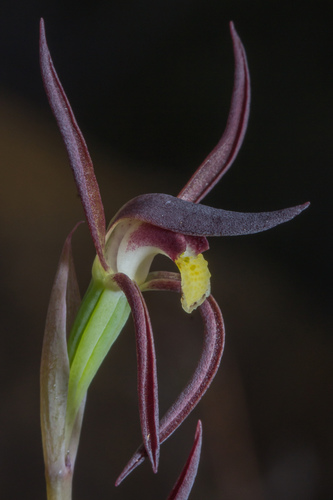
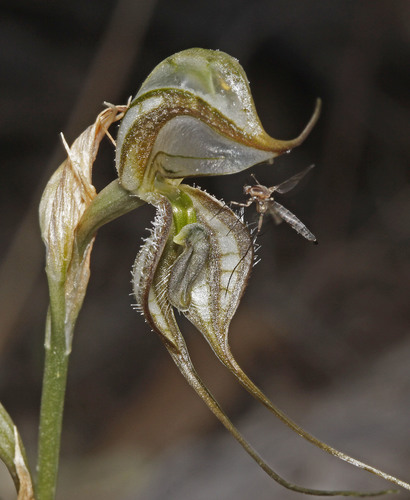
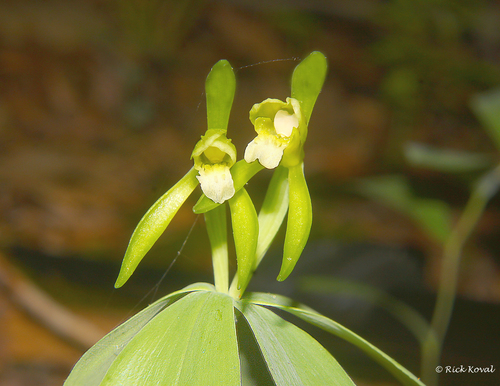
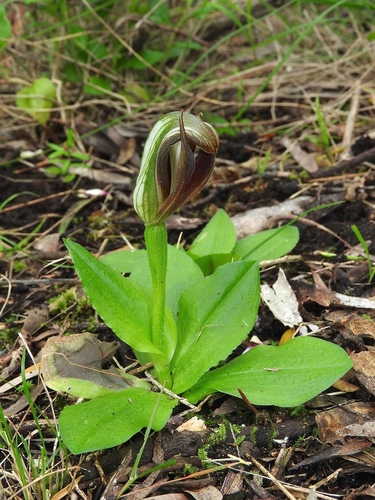
Pterostylis cucullata R.Br. is a terrestrial, perennial, deciduous herb that grows from an underground tuber. It produces between four and seven egg-shaped to oblong leaves. Some of these leaves form a rosette at the base of the plant, while others partially wrap around the flowering stem. The leaves are 40–100 mm (2–4 in) long and 15–30 mm (0.6–1 in) wide, with a dark green, fleshy, flat texture. A single flower, colored white, green, and reddish-brown, is borne on a flowering stem that reaches 50–250 mm (2–10 in) in height. The flower itself is 35–40 mm (1–2 in) long and 20–25 mm (0.8–1 in) wide. The dorsal sepal and petals are joined, curving forward into a semi-circle to form a hood called the "galea" that covers the column. A wide gap exists on each side of the flower between the petals and the lateral sepals. The lateral sepals have tapering tips 20–25 mm (0.8–1 in) long, which are only slightly longer than the galea, and there is a narrow but deep notch in the sinus between the two lateral sepals. The labellum is 14–17 mm (0.6–0.7 in) long, about 4 mm (0.2 in) wide, slightly curved, dark brown, and blunt-tipped, and it only protrudes slightly above the sinus. Flowering takes place from August to October. This species, commonly called the leafy greenhood, is widely distributed across Victoria, South Australia, and Tasmania, but only occurs in small, isolated populations. Both of its subspecies are present in Victoria, where they grow as small groups in coastal areas and along inland watercourses. In South Australia, it grows on shady forest slopes, but it is very rare in this state. It is considered extinct on the main island of Tasmania and King Island, and is currently only found on Hunter Island and Three Hummock Island in Bass Strait.