About Pterostylis arenicola M.A.Clem. & J.Stewart
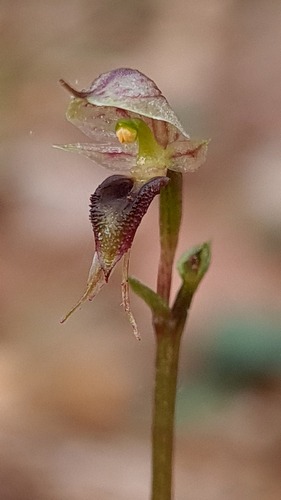
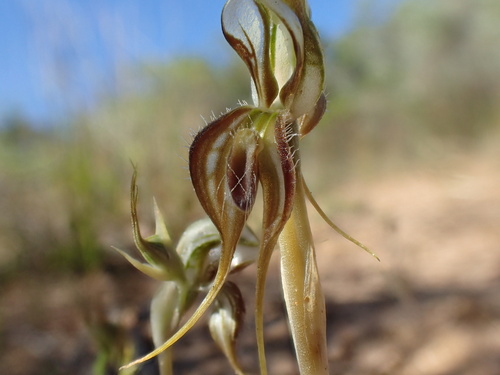
Pterostylis arenicola is a terrestrial, perennial, deciduous herb with an underground tuber that always grows as a solitary plant. It produces a basal leaf rosette of 8 to 12 leaves at the base of its flowering spike. Each leaf measures 15–30 mm (0.6–1 in) long and 6–12 mm (0.2–0.5 in) wide, and withers as flowers develop. Up to ten dark brown and translucent white flowers are borne on a flowering spike that elongates to 100–250 mm (4–10 in) tall as flowers mature; each flower is 30–35 mm (1.2–1.4 in) long and 10–12 mm (0.4–0.5 in) wide. The dorsal sepal and petals form a hood called the "galea" that covers the column, and the dorsal sepal has a narrow tip 9–12 mm (0.4–0.5 in) long. The lateral sepals are much wider than the galea, have densely hairy edges, and taper suddenly to narrow, thread-like tips 10–20 mm (0.4–0.8 in) long that spread apart from each other. The labellum is dark brown, fleshy, and insect-shaped, 5–7 mm (0.2–0.3 in) long and about 2 mm (0.08 in) wide. A channel runs through the centre of the labellum, and the edges bear bristly hairs up to 3 mm (0.1 in) long. Flowering of this species takes place from August to October. Common name sandhill rustyhood, this orchid is only confirmed to occur in specific South Australian locations: populations at Grange and West Lakes in the Adelaide metropolitan area, the region between Tailem Bend and Wellington, and an area south-east of Langhorne Creek near the lower Murray and Murray Lakes. It is locally common growing in sandy soil on coloured sand dunes, in mallee and Callitris woodland with an understorey of shrubs, heath, sedges and grasses. While there are records of this species from Victoria, those records may not actually refer to Pterostylis arenicola. Successful in vitro germination of Pterostylis arenicola seeds has been achieved by inoculating the seeds with a mycorrhizal fungus.