About Pterostoma palpina (Clerck, 1759)
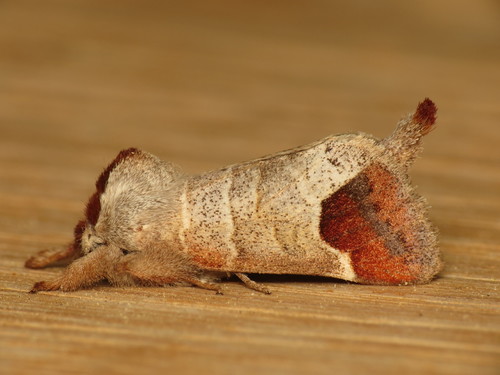
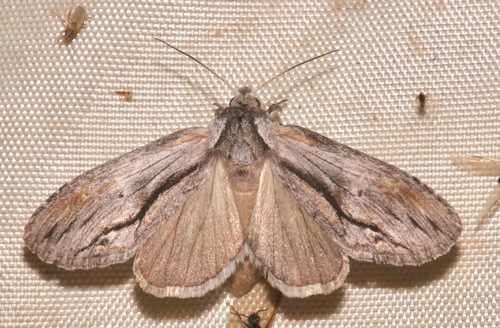
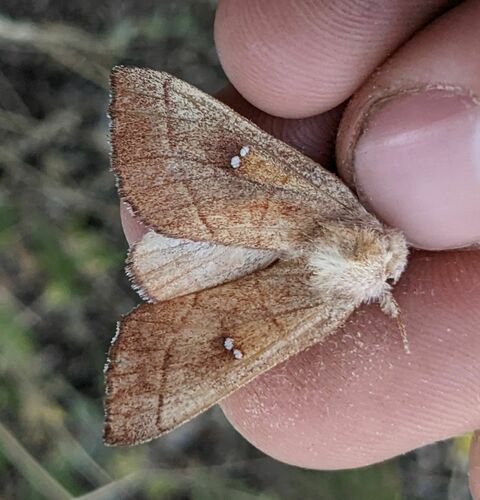
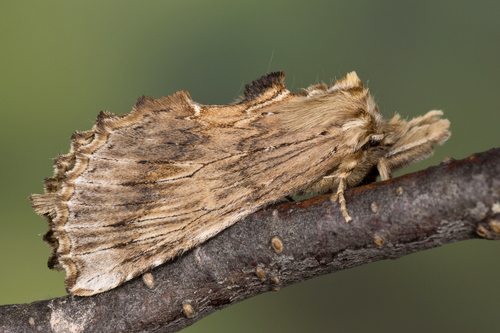
Pterostoma palpina (Clerck, 1759) has a wingspan ranging from 35 to 52 mm. Beyond its tooth-like forewing projection covered in black scales, the inner margin of the forewing is notched. Long labial palps and tufts on the tail segment give the moth an elongated overall appearance. Female antennae are pectinated, but their teeth are shorter than those of males, and the blackish streaks on the wings are usually less defined. Apart from some specimens having stronger markings than others, there is very little overall variation in the species.
The larva is bluish green, with white dorsal and lateral lines, and a yellow stripe edged in black along the spiracles; this stripe has reddish markings on the three anterior segments. According to Seitz, first brood specimens are larger and predominantly grey-brown, while second brood specimens are smaller and light straw-colour. The transverse bands of the forewing are only indicated by black vein dots; the postdiscal band is more complete than the other transverse bands, marked by double dots separated by white and placed in a slightly darkened shadowy band. All veins are more or less extensively black; the proximal scale lobe of the hind margin is mostly black. The hindwing shares the same ground colour as the forewing, and has a lighter median band.
This species is distributed across most of Europe, excluding Greece; it is also found in North-West Africa, northern Asia Minor, and Amurland. In Central Europe, there are two broods, active from April to May and July to August. Northward from the Baltic provinces of Russia, there is only one brood, active from May to June.
The Lapland form, lapponica Teich, is uniformly dark grey-brown, and lacks the light median band of the hindwing. Another dark form is found around the Black Sea and in Southern Siberia, and is presumably more widely distributed across Central Asia. This form is pontica Stgr., now classified as subspecies P. palpina pontica Staudinger, 1901, in which the light band of the hindwing is barely visible.
The egg is distinctly globose, whitish green with a darker spot at the pole. The larva is light bluish green, with 6 rows of raised white dots: 4 dorsal rows and 2 lateral rows. Above the spiracles there is a white longitudinal stripe that is thinly edged with fuscous on the anterior end, and has a red streak at the prothoracical stigma. Larvae can be found from May to October feeding on poplar, oak, lime, and willow (Salix). The pupa is dark red-brown.
The adult moth is very common, and usually rests on the bark of poplars or willows, in spots where light wood shows through damaged bark. The moth matches the colour of these light spots. When held in a steep roof-like position, the wing markings make the moth look exactly like a splinter of wood, with the palps representing the split end of the splinter. This resemblance is especially striking when a mating pair is positioned together. The species occurs across Europe and Central Asia in the Palearctic realm.