About Pteropus vampyrus (Linnaeus, 1758)
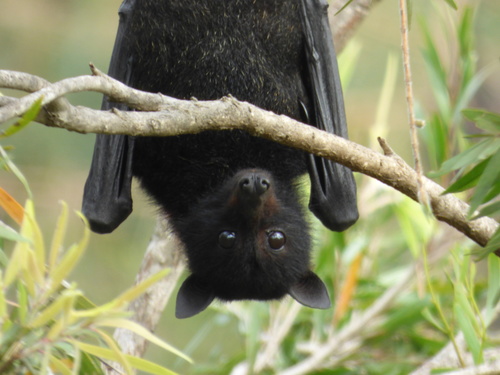
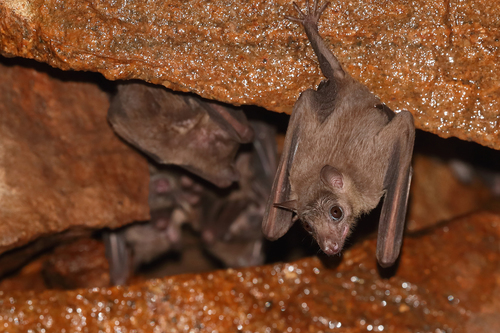
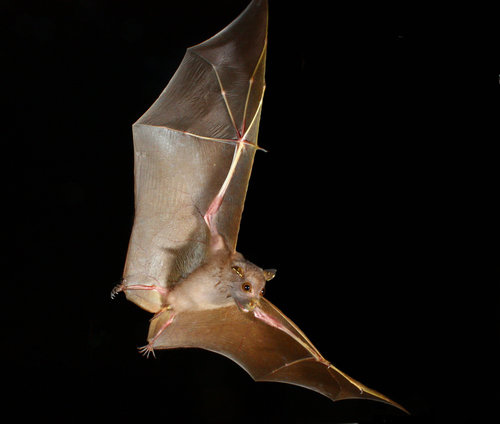
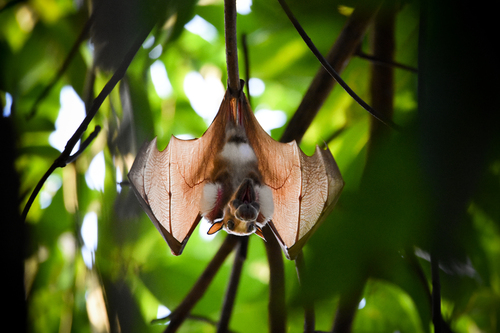
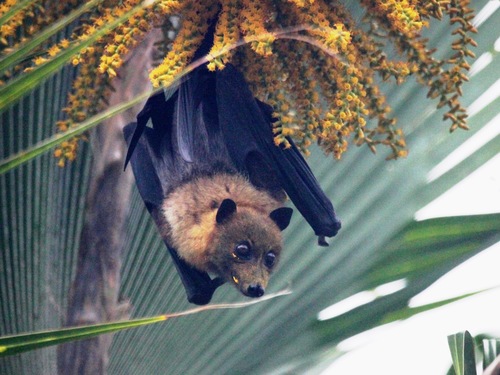
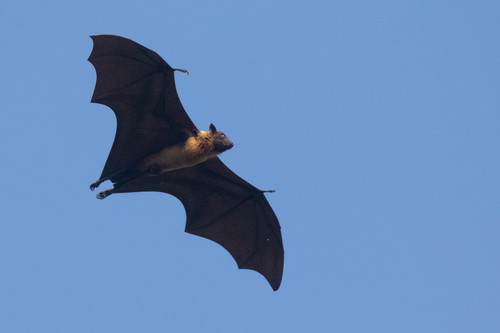
The large flying fox, Pteropus vampyrus, is counted among the largest bat species in the world. It has a weight range of 0.65–1.1 kg (1.4–2.4 lb), a maximum wingspan of 1.5 m (4 ft 11 in), a head-body length of 27–32 cm (11–13 in), and a forearm length of 180–220 mm (7.1–8.7 in). Like most megabats, it has a fox-like face, no tail, and pointed ears. Most of its body is covered in long, woolly hairs, while hairs on the upper back are shorter and more erect. The longest hairs on its body are found on its mantle. Coat color and texture differ between sexes and age groups: males generally have slightly stiffer, thicker coats than females. Immature individuals are almost entirely a dull gray-brown, and juveniles have a dark mantle that lightens as males mature. Head hairs range in color from mahogany-red and orange-ochreous to blackish. Ventral areas are brown or blackish, tinged with chocolate, gray, or silver. The mantle can range from pale dirty-buff to orange-yellow, while the chest is usually dark golden brown or dark russet. This species has a large, robust skull, with a dental formula of 2.1.3.2 / 2.1.3.3, giving it a total of 34 teeth. Its wings are short and somewhat rounded at the tips; this wing shape allows slow flight with high maneuverability. Wing membranes only have hair near the body. The large flying fox’s range extends from the Malay Peninsula east to the Philippines, and south to the Indonesian Archipelago islands of Sumatra, Java, Borneo, and Timor. In some regions it favors coastal areas, but it can also be found at elevations as high as 1,370 m (4,490 ft). It inhabits a variety of habitats including primary forest, mangrove forest, coconut groves, mixed fruit orchards, and other areas. During the day, it roosts in trees located in mangrove forests and coconut groves. In Malaysia, it prefers lowland habitats below 365 m. In Borneo, it lives in coastal areas and travels to nearby islands to feed on fruit. Roost colonies can number up to thousands of individuals. A colony of around 2,000 individuals was recorded in a Timor mangrove forest, and colonies of 10,000 to 20,000 individuals have also been reported. In general, mangrove roosts hold fewer bats than lowland roost sites, which suggests mangrove forests may only be used as temporary roosts. This species feeds primarily on flowers, nectar, and fruit, and prefers flowers and nectar when all three food sources are available. Commonly consumed foods include pollen, nectar, and flowers from coconut and durian trees, fruits from rambutan, fig, and langsat trees, and it also eats mangoes and bananas. When feeding on fruit, it prefers the pulp, and slices open the fruit rind to access it. When licking nectar from durian tree flowers, it causes no visible damage to the flower. The large flying fox acts as a host for the acanthocephalan intestinal parasite Moniliformis convolutus.