About Pteropus poliocephalus Temminck, 1825
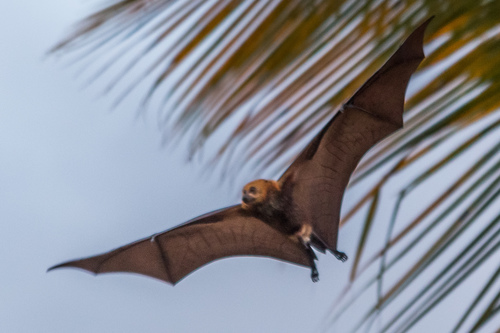
Pteropus poliocephalus Temminck, 1825, commonly known as the grey-headed flying fox, is the largest bat found in Australia. Adult individuals reach a maximum wingspan of 1 m (3 ft 3 in) and a maximum weight of 1 kg (2.2 lb). Body weight typically ranges from 600 to 1,000 g (21 to 35 oz), with an average weight of 700 g (25 oz). Combined head and body length measures 230 to 290 mm, forearm length ranges 138 to 180 mm, and ear length from base to tip measures 30 to 37 mm.
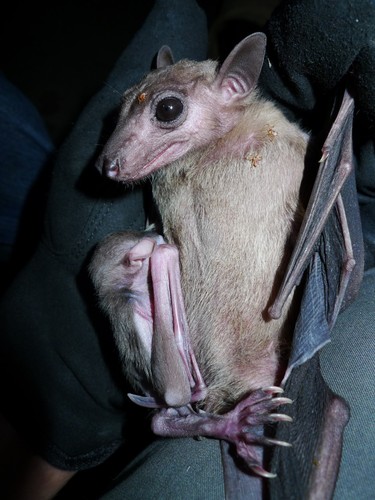
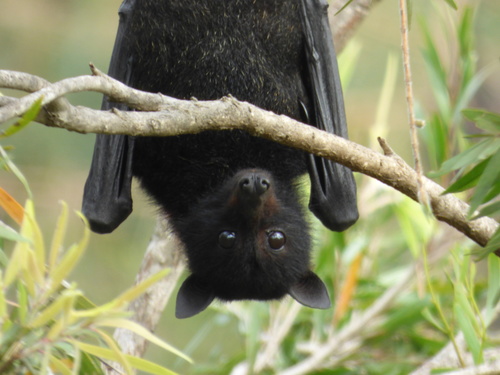
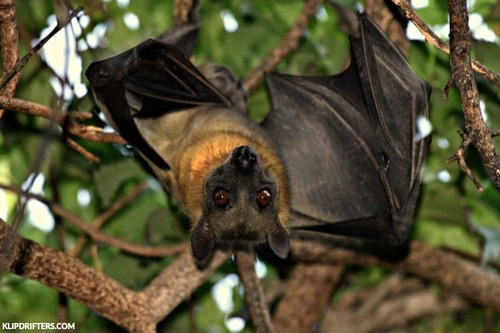
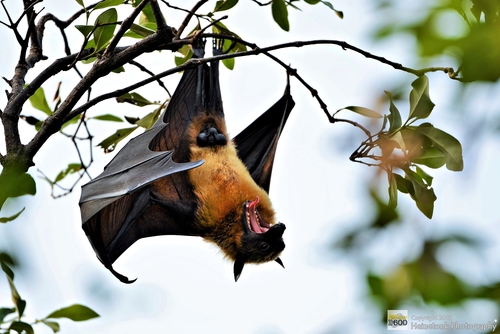
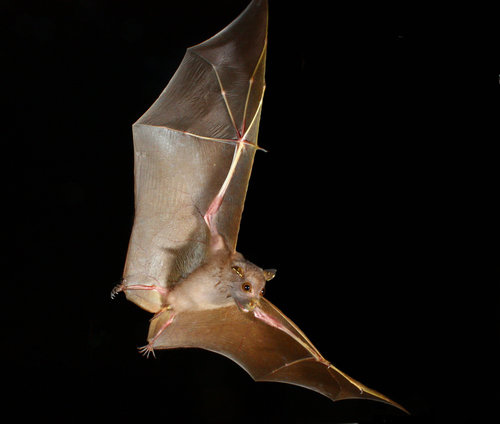
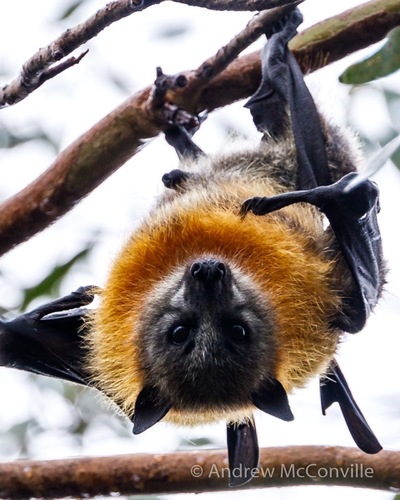
The species' overall pelage has a dark-grey body and a light-grey head, separated by a distinct reddish-brown, golden-orange collar that fully encircles the neck. Body fur is long and streaked with grey. A unique trait among bats of the genus Pteropus is leg fur that extends all the way to the ankle. Like other megachiropterans, this species has no tail. All individuals have claws on their first and second digits. The head has a simple shape, with the characteristic 'dog-like' appearance of the genus. Since this species does not use echolocation, it lacks the tragus or leaf-shaped facial ornamentation seen in many Microchiroptera species. It depends on smell and primarily sight to find its food, which consists of nectar, pollen and native fruits, so it has relatively large eyes for a bat. The vocalizations of P. poliocephalus are a complex series of squeals and screeches. In hot weather, the bats flap their wings, using blood pumped through the patagium to lower their body temperature. The species is long-lived for a mammal of its size: captive individuals have been reported to live up to 23 years, and wild individuals can reach a maximum age of up to 15 years. Grey-headed flying foxes are known to enter torpor.
The species is distributed across eastern Australia, occurring mostly within 200 kilometres of the coast, from Gladstone in Queensland south to the southern Gippsland region and around the city of Melbourne. Its breeding range has been recorded shifting southward; it now occurs in the temperate climates of Melbourne and Geelong, and is found no further north than Maryborough, Queensland. Urbanisation may displace the species, or create habitat that suits its feeding or roosting preferences. Brisbane has many roosts for the species, with a well-known colony on Indooroopilly Island noted for the evening departure of bats across the local river. In Sydney's central business district, the bats can be seen travelling along city streets to feed on Moreton Bay fig trees in Hyde Park. The species was originally an occasional visitor to Canberra, Australia's national capital, but more permanent camps have recently been established near the city close to flowering eucalypts in Commonwealth Park. During 1920s surveys conducted by Francis Ratcliffe, he estimated camp populations in the hundreds of thousands to millions, with camps generally located around 40 kilometres apart. Population numbers have declined greatly since this first survey.
Grey-headed flying foxes occupy a variety of habitats, including rainforests, woodlands, and swamps. Their roosts, called 'camps', vary in size and are seasonally relocated. During warmer months, large groups occupy cool, wet gullies. During the day, individuals live in large roosts (colonies or camps) that range from hundreds to tens of thousands of individuals. Colonies form in what appear to be arbitrary locations. Roost vegetation includes rainforest patches, stands of melaleuca, mangroves, and riparian vegetation, but roosts also occur in heavily modified urban vegetation. A well-known camp existed for many years at the Royal Botanic Gardens in Sydney, however the gardens implemented a controversial policy to remove the bats from the grounds, and the camp is now dispersed across Queensland.
Movement of grey-headed flying foxes is shaped by food availability. Their population is very fluid, as they move in response to the irregular blossoming of certain plant species. They are keystone pollinators and seed dispersers for over 100 species of native trees and plants. The grey-headed flying fox is a partial migrant that uses winds to aid long-distance movement. It does not migrate in a consistent direction, instead moving in the direction that is most beneficial at the time. Though small numbers were recorded sporadically through the 20th century, grey-headed flying foxes did not visit Melbourne regularly until the 1980s, and a permanent camp has existed there since the 1990s. Their residence at the Royal Botanic Gardens Victoria was controversial, and the bats were eventually discouraged from roosting there, moving to Yarra Bend along the city's river. The Yarra Bend camp was heavily damaged by a heat wave, requiring rehabilitation to support the relocated population. Forced relocations are also reported to have led the bats to discover orchards in the Goulburn Valley. Similarly, the first recorded permanent camp in Adelaide was established in 2010. The species' southward spread is likely caused by global warming, habitat loss and drought, while the location of new camps appears to be a response to urbanisation, which provides a reliable food supply such as native eucalypt plantings and backyard fruit trees, and warmer temperatures from climate change and urban heat islands. As of 2024, the species has been spreading westward, with camps spotted in Port Augusta on the Eyre Peninsula.
Mating is generally observed between March and May, with conception most likely occurring in April. Most mating occurs within territories during the day. Females control the copulation process, and males may need to mate multiple times with the same female. Females usually give birth to one young per year. Gestation lasts approximately 27 weeks, and pregnant females give birth between late September and November. Late births in January are sometimes observed. Newborns are altricial and depend on their mothers for warmth. For their first three weeks, young cling to their mothers when they go foraging. After this period, the young remain behind in the roost. By January, young are able to sustain flight, and they are fully weaned by February, March, or April.