About Pteropus lylei K.Andersen, 1908
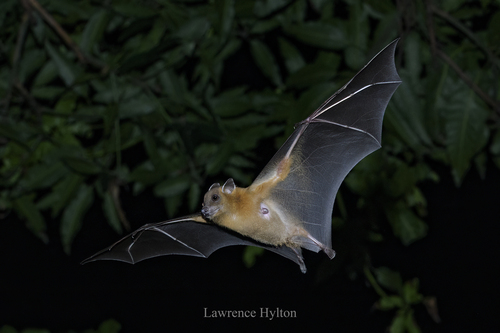
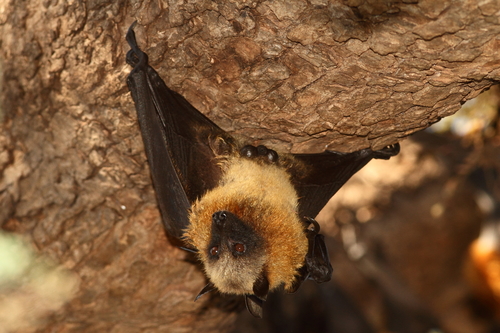
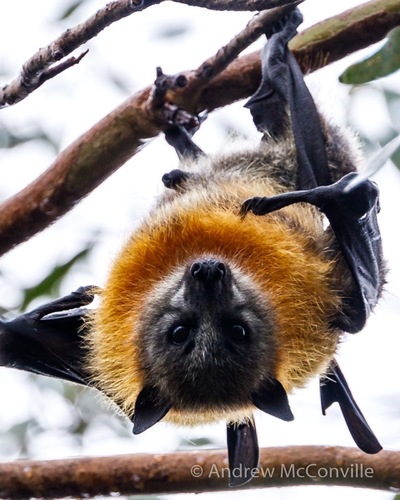
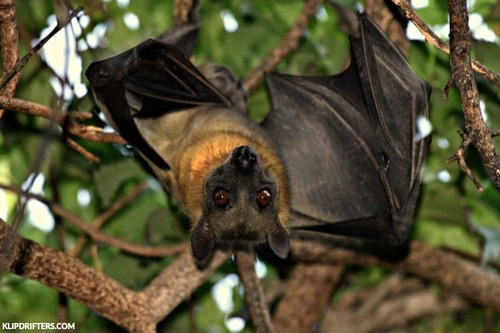
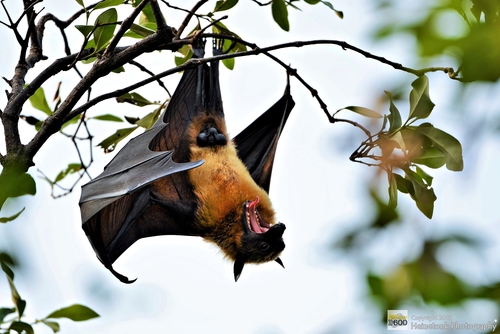
Lyle's flying fox is a moderate-sized species. It has a long snout, large eyes, pointed ears, and a fox-like face. Most of its upper body fur is blackish, apart from a broad collar of orange fur; its lower body is sometimes dark brown or yellowish-brown. Its wings are black or dark brown, and its underparts are dark brownish-black. Lyle's flying fox is endemic to the countries of southern Asia adjacent to the Gulf of Thailand, with a range that extends from southern Thailand through central and southern Cambodia to the extreme southwestern part of Vietnam. It has also been detected in Yunnan Province, China. This species is gregarious, and roosts in tropical and subtropical forest, mangrove forests, and can also be found in plantations and secondary forests. A colony of thousands of bats, made up of this species mixed with the large flying fox, is located at the Bat Pagoda (Khmer Chùa Dơi) in Sóc Trăng city, in the Mekong Delta region of Vietnam. At this site, the bats roost in trees on the temple grounds and are protected by monks. Like other flying foxes, Lyle's flying fox feeds on fruit; its confirmed diet includes mango, cashew, monkey jack, sapodilla, dragonfruit, Java apple, tamarind, jambolan, and roseapple. It chews fruit and spits out most seeds, but some seeds are swallowed and pass through the bat, leading to seed dispersal. The bat also feeds on flowers, nectar, and pollen. While foraging, it visits orchards, and may fly 50 km (31 mi) between roosts. Lyle's flying fox feeds at night, but its roosting colonies high in trees are quite active during the day, with mothers feeding their young, and bats moving around and vocalizing. This bat is a reservoir for Nipah virus, the pathogen that causes a newly emerged neurological and respiratory disease first reported in 1998. The virus is harmless to bats, but can cause fatal disease in pigs and humans.