About Pteroptochos megapodius Kittlitz, 1830
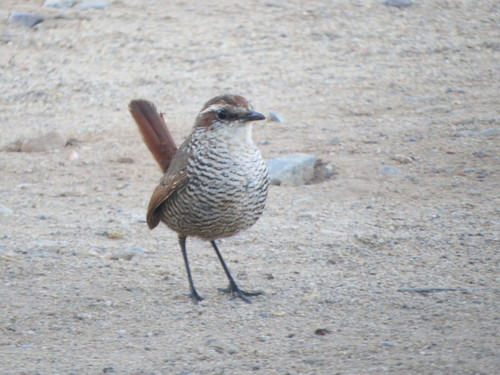
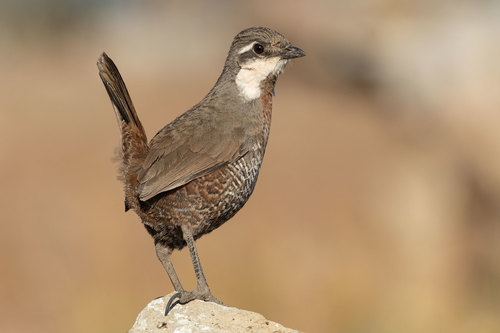
The moustached turca (Pteroptochos megapodius) is a stocky bird, measuring roughly 22.5 cm (8.9 inches) long and weighing between 95 and 125 grams (3.4–4.4 oz). It has a thick bill, a habit of holding its tail cocked, and disproportionately large feet—the feature that gives the species its scientific name. Adult plumage is mostly cinnamon brown, with white barring across the breast, belly, and undertail-coverts. The crown of the head is often gray-brown. The species has a dark eyestripe, a white eyebrow, and a broad white stripe running along the sides of the throat. Adult bills and legs are black. Juveniles overall resemble adults, but differ in having an unbarred rump and fainter barring on the flanks. Male and female plumage is identical, but females are typically smaller than males. The atacamae subspecies is smaller than the nominate subspecies, paler overall, and has whiter underparts. The only species the moustached turca could be confused with is the white-throated tapaculo (Scelorchilus albicollis), which lives in similar habitat. However, the white-throated tapaculo is smaller and lacks the moustached turca's distinctive white throat stripe. This species is endemic to Chile. The nominate subspecies P. m. megapodius occurs in central Chile, from the center of the country toward the southern end of its range. The isolated subspecies P. m. atacamae is found in Chile's Atacama Region. All recorded reproductive individuals have been found between sea level and 2,000 metres (6,600 ft) in the Andean foothills, but some non-reproductive individuals have been recorded at altitudes as high as 3,200 metres (10,500 ft). In general, the species inhabits hillsides with some shrub and low tree cover. It favors areas with low soil moisture, and the atacamae subspecies occurs only in semi-desert regions with scattered rocks and boulders. More information is needed on the species' specific habitat requirements. Historically, based on 1904 observations by Reed and 1929 observations by Passler, the species' southern distribution limit was thought to be the Concepción region, and the northern limit the Coquimbo region. This range has been widely debated since that time. In 1946, Goodall et al. proposed the Huasco river as the new northern limit, and reaffirmed Concepción as the southern limit. In 2004, Marin identified Quebrado El León as the northern limit and Las Trancas as the southern limit. More recently, current eBird observations have narrowed the northern limit to Parque Nacional Llanos Challe, and shifted the southern limit much farther north, to the Rauco region. No moustached turca observations have been recorded south of Rauco. This matches other records indicating the species' southern limit was the Constitución region before the establishment of forest plantations. Passler's 1929 records from the Concepción region were most likely of the black-throated huet-huet, Pteroptochos tarnii. The moustached turca is primarily a ground-dwelling bird that can run quickly. It rarely flies, and only takes short flights when it does. Known predators of the species include Harris's hawk (Parabuteo unicinctus), the bicolored hawk (Accipiter bicolor), the austral pygmy owl (Glaucidium nanum), and the barn owl (Tyto alba). No predation on eggs in nests has been observed. Nesting begins in July, and chicks hatch between August and December. Adults have been observed starting nests at the end of July. Adults have been recorded carrying food to nests as late as January, indicating young are still being reared at that time. The moustached turca digs tunnels 0.4–2.2 metres (16–87 in) deep into earth banks on steep rocky hillsides. The tunnel entrance is not covered by vegetation, but the steep slope is thought to provide good protection from predators. At the end of the tunnel is a cavity roughly 25 centimetres (9.8 in) wide that holds the nest. The nominate megapodius subspecies lays slightly larger eggs: with a mean length of 35.3 millimetres (1.39 in) and mean width of 26.6 millimetres (1.05 in), compared to the atacamae subspecies' mean egg length of 32.1 millimetres (1.26 in) and mean width of 24.6 millimetres (0.97 in). Clutch size also differs between the two subspecies: megapodius usually lays 2 eggs, occasionally a third, while atacamae usually lays 3 eggs. All eggs are white. More research is needed on the post-reproductive behavior of adult and juvenile moustached turcas.