About Pteroplatytrygon violacea (Bonaparte, 1832)
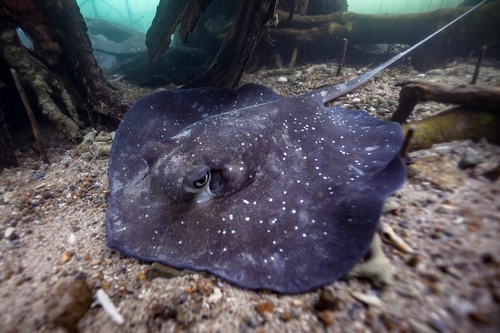
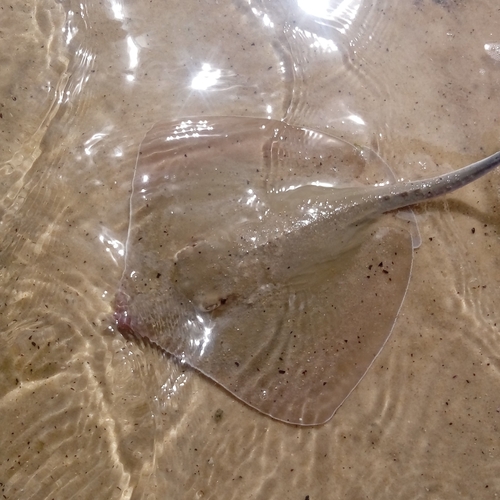
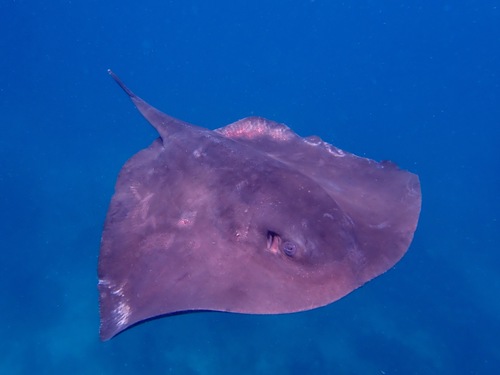
The pelagic stingray, scientific name Pteroplatytrygon violacea (Bonaparte, 1832), has a very thick, distinctively wedge-shaped pectoral fin disc that is one-third wider than it is long. The disc has broadly curved leading margins, somewhat angular outer corners, and nearly straight trailing margins. Its snout is short with a rounded tip, its eyes are minute and do not protrude above the body unlike other stingrays, and paired respiratory openings called spiracles sit immediately behind the eyes. There is a short but broad curtain of skin between its nostrils, with a weakly fringed rear margin. The mouth is small and gently arched, with deep furrows at the corners and a tiny projection at the center of the upper jaw that fits into an indentation on the lower jaw. A row of 0 to 15 forked, nipple-like structures called papillae runs across the floor of the mouth. There are 25–34 upper tooth rows and 25–31 lower tooth rows; teeth of both sexes have single, pointed cusps, but adult males have longer, sharper teeth than adult females. The front margins of the pelvic fins are nearly straight, and the tips and rear margins are rounded. The whip-like tail grows up to twice as long as the disc; it is thick at the base and tapers significantly to an extremely long, serrated spine that sits roughly one-third to halfway along the tail's length. Two spines may be present if a replacement spine grows in before the original spine falls off. Behind the origin of the spine, there is a low ventral fin fold that does not extend all the way to the spine's tip. Young pelagic stingrays have completely smooth skin; as they age, small prickles develop over the center of the back, plus a row of small thorns along the midline running from between the eyes to the origin of the spine. This species is a plain dark purple to blue-green on its upper surface, with this color extending onto the tail fold, and is a slightly lighter shade on its underside. When captured and handled, it exudes thick black mucus that covers its body. This species typically reaches 1.3 m (4.3 ft) in total length and 59 cm (23 in) across the disc. The largest recorded individuals came from a captive rearing experiment run from 1995 to 2000: a male reached 68 cm (27 in) across the disc and 12 kg (26 lb), and a female reached 94 cm (37 in) across the disc and 49 kg (108 lb).
The pelagic stingray has an almost worldwide distribution in tropical to warm-temperate open pelagic waters, between the latitudes of 52°N and 50°S. In the western Atlantic, it has been recorded from the Grand Banks of Newfoundland to North Carolina, the northern Gulf of Mexico, the Lesser Antilles, Brazil, and Uruguay. In the eastern Atlantic, it has been found from the North Sea to Madeira (including the Mediterranean), as well as around Cape Verde, in the Gulf of Guinea, and off South Africa. In the Pacific, it occurs from Japan to Australia and New Zealand in the west, from British Columbia to Chile in the east, and around many oceanic islands including Hawaii, the Galápagos, and Easter Island. It has not been reported from most of the Indian Ocean, but it is known to be common in the southwestern portion of the ocean and around Indonesia. Unique among stingrays for living in the open ocean rather than on the seafloor, the pelagic stingray is generally found from the surface down to a depth of 100 m (330 ft) over deep water. It has also been caught at depths of 330–381 m (1,083–1,250 ft) over the Kyushu–Palau Ridge, showing that it at least occasionally approaches the seabed. This species prefers water temperatures above 19 °C (66 °F), and will die if the temperature drops to 15 °C (59 °F).
The pelagic stingray makes seasonal migrations that follow warm water masses. In the northwestern Atlantic, it occurs in or near the Gulf Stream from December to April, and moves north of the Gulf Stream to gather near the continental shelf from July to September. A similar migration is thought to occur in the Mediterranean, though specific details are not known. In the Pacific, this species apparently spends winter in oceanic waters near the equator, and moves into higher latitudes and towards the coast in spring. Two migratory Pacific populations are known: one travels from near Central America to California, and the other travels from the central Pacific as far as Japan and British Columbia. Off southeastern Brazil, pelagic stingrays are pushed towards the coast by cold water upwellings in late spring and summer; in some years, they may even be pushed into inshore waters less than 45 m (148 ft) deep.
Because it has adopted a midwater open-ocean lifestyle, the pelagic stingray has several traits that differ from its bottom-dwelling relatives. Most stingrays swim by undulating the edges of their disc, but this species swims by oscillating (flapping) its pectoral fins in a style close to the "underwater flying" used by eagle rays. Oscillatory fin movement generates lift, which improves open-ocean cruising efficiency but reduces maneuverability. The pelagic stingray is skilled at swimming backwards, which may make up for the lower fine control provided by its swimming method. Vision is likely more important for finding food in the pelagic stingray than it is in other stingrays. Compared to other members of its family, this species has less than one-third the density of electroreceptive ampullae of Lorenzini on its underside. The ampullae also cover a smaller area (though not as small as they are in eagle rays), and are more evenly distributed between the ventral and dorsal body surfaces. This ray can detect an electric field of well under 1 nV/cm at a distance of up to 30 cm (12 in), and may be able to pick up the minute electric fields produced by moving seawater. The pelagic stingray's lateral line, a complex system of mechanoreceptors that detect nearby movement and ocean currents, is similar to that of other stingrays in covering a larger area on the ventral than the dorsal surface. However, this species is less responsive to mechanical stimuli than it is to visual stimuli. Pelagic stingrays may segregate by sex: males are found in deeper water than females, and horizontal segregation may also occur. Captive pelagic stingrays often behave very aggressively towards ocean sunfish (Mola mola), biting and harassing them, especially when they are hungry. This species is preyed on by oceanic whitetip sharks (Carcharhinus longimanus), great white sharks (Carcharodon carcharias), toothed whales, and other large ocean-going carnivores. Its uniform dark coloration likely works as camouflage against its featureless open-ocean habitat. The venom on its tail spine is quite potent, so other fish avoid the species. Known parasites of the pelagic stingray include the tapeworms Acanthobothrium benedeni, A. crassicolle, A. filicolle, Rhinebothrium baeri, R. palombii, and Tetragonocephalum uarnak, and the monogenean Entobdella diadema.