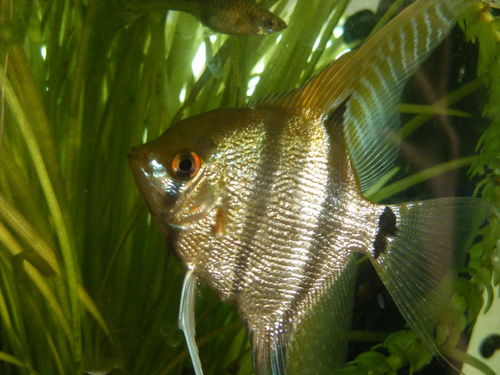
About Pterophyllum scalare (Schultze, 1823)
Pterophyllum scalare, most commonly called angelfish or freshwater angelfish, is the most common species of the genus Pterophyllum kept in captivity. It is native to the Amazon Basin, occurring in Peru, Colombia, and Brazil; specific regions it inhabits include the Ucayali River in Peru, the Oyapock River in French Guiana, the Essequibo River in Guyana, and the Solimões, Amapá, and Amazon rivers in Brazil. This species lives in swamps or flooded areas with dense vegetation, where the water is either clear or silty. In its native habitat, water pH ranges from near 6.0 to a neutral 7.0, general water hardness (gH) falls between 3 and 10 °dH, and water temperature ranges from 26 to 30 °C (75 to 86 °F). This species is the angelfish most commonly found in the aquarium trade. A population of P. scalare capable of cross-breeding with the main species lives in the Rio Orinoco. This Orinoco population matches the main species in size and shape, differing only in stripe patterning: Orinoco P. scalare have two thinner stripes instead of the typical patterning. The natural diet of Pterophyllum scalare includes a wide range of prey: tiny fish fry, juvenile fish, young and mature shrimp, crabs, prawns, various worms, mosquito larvae, and water bugs. They also opportunistically feed on any small floating insects that fall onto the water surface. In captivity, this species is not a picky eater. It readily accepts different types of frozen, freeze-dried, and live foods, including tubifex worms, bean beetles and their larvae, bloodworms, brine shrimp, daphnia, flour beetles, krill, springtails, small or finely chopped earthworms, black soldier fly larvae, and cultured wingless fruit flies (Drosophila melanogaster). Tubifex worms and fruit flies are particularly high in protein and other nutrients, which supports very substantial growth. A diet based mostly on live foods also provides the nutrients needed for improved reproductive performance. Overall, offering a variety of foods is key to good health, and also helps mimic the species' natural feeding habits. Pterophyllum scalare was first described by Ferdinand Schultze in 1823, in a catalog of specimens from the Zoological Museum of the Royal University of Berlin published by Hinrich Lichtenstein. It was first imported to Europe (Germany, Hamburg) by C. Ziggelkow in 1909. In 2022, the genome of this angelfish was sequenced and assembled by high school student Indeever Madireddy.