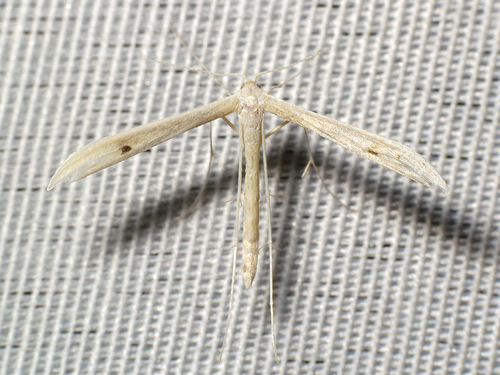
About Pterophorus innotatalis (Walker, 1864)
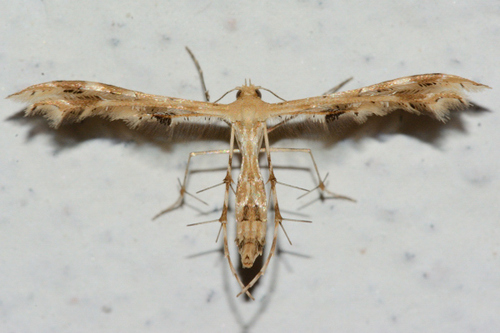
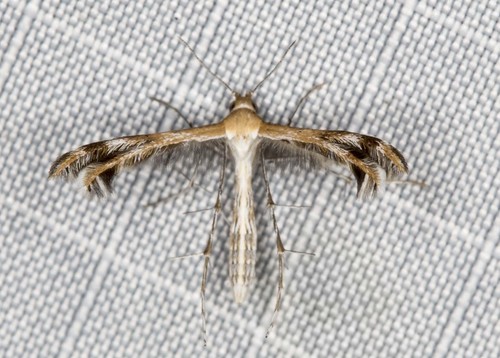
The larvae of Pterophorus innotatalis are small and very hairy. Walker described the adult male of this species as follows: Pale ochraceous, slender. Legs silvery whitish, without any markings. The plumes of the wings are extremely narrow. Fore wings unvaried, very acute. Hind wings cinereous-seneous, divided at the base into two plumes. Body length is 4 lines; wing length is 10 lines. Meyrick described the adult of this species for both males and females as follows: 15-16 mm wingspan. Head, palpi, antennae, thorax, and abdomen pale ochreous. Legs ochreous-whitish, with the anterior pair internally fuscous. Forewings pale whitish-yellowish, suffused with pale ochreous on the anterior half. Cilia are dark fuscous, becoming yellow-whitish on the costa before the apex; on the lower margin of the second segment, cilia generally contain a black dot before the middle of the segment and another beyond it. Hindwings dark grey; cilia fuscous-grey. This species is endemic to New Zealand. It has been recorded in the North Island, the South Island, and at Ruapuke Island. It has been found at altitudes up to 1500 m. Pterophorus innotatalis inhabits grass or fern-covered hills. Its larvae are leaf miners that feed on Dichondra species, including Dichondra brevifolia and Dichondra repens. The last larval instar feeds on both sides of the leaves of its host species.