About Pterophorus furcatalis (Walker, 1864)
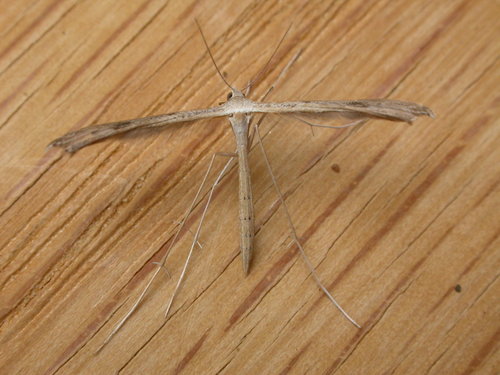
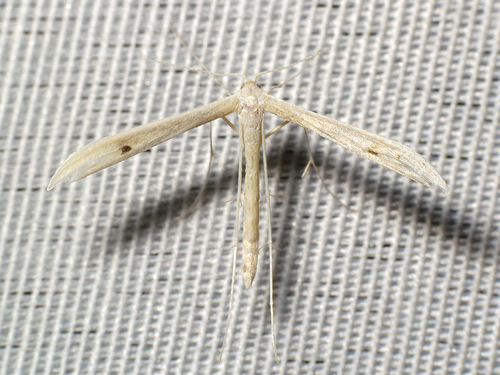
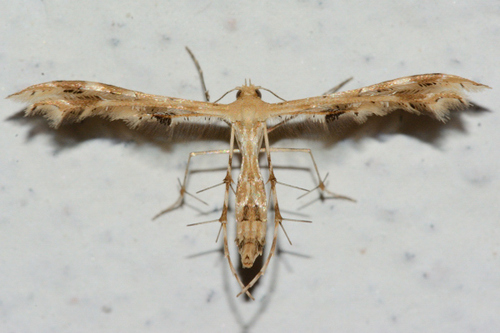
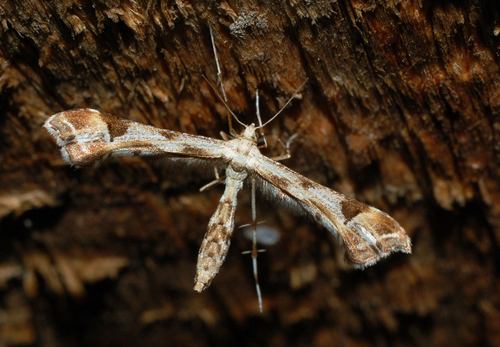
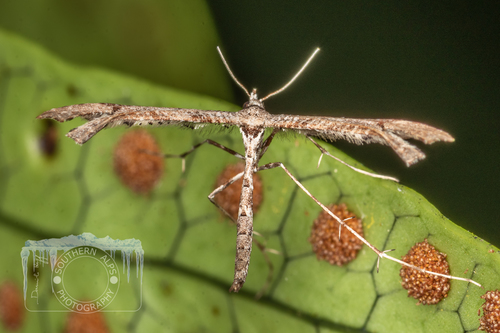
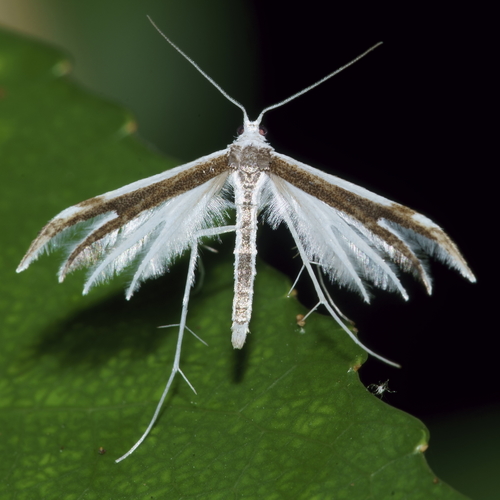
This species has the scientific name Pterophorus furcatalis (Walker, 1864). In 1928, Hudson illustrated the egg of this species. Hudson later described the full-grown larva as about 3⁄8 inch long, very stout, rapidly tapering toward the posterior, with well-defined segments. Its general color is pale green, darker along the back, and the edges of the darker dorsal band are outlined with whitish. The sides of the head are pale brown. Each segment has a row of long, very stout, blackish-brown bristles, plus tufts of short whitish hairs near the ventral surface. This description was repeated by Hudson in 1939, when he added details about pupation: the larva creates a large silk pad on a support, and the pupa attaches to this pad using its entire flattened ventral surface. Hudson also described the pupa itself: it is about 5⁄16 inch long, stout, rapidly tapering toward its extremity, and uniform grass green in color. The pupa's integument is polished, slightly and irregularly striated, with a row of impressions on each side of the abdominal segments. Its limbs are very faintly sculptured, and it has no hairs or bristles. For adult Pterophorus furcatalis, Hudson recorded a wing expansion of about 7⁄8 inch. Forewings are brown, with the outer two-thirds of the costa broadly edged with white, and a small white mark near the middle of the first plume. Hindwings are snow white. The head is white, while the dorsal surfaces of the thorax and abdomen are brown. All cilia are white, except for a brown patch near the extremity of the second plume on the forewings. Some individuals have markings of a darker brown shade. This species can potentially be confused with the brown streak form of P. monospilalis, but it can be distinguished by two key features: the second plume of P. furcatalis is brown, while the second plume of P. monospilalis is white, and P. furcatalis has a brown streak running down the dorsal side of its abdomen. This species is endemic to New Zealand, and can be found throughout the country across the North Island, South Island, and Stewart Island. It inhabits dense native forest. Its known larval host plants are Pittosporum eugenioides and Pittosporum crassicaule. Larvae reared on P. crassicaule develop into pupae that are strongly spotted with black.