About Pterophanes cyanopterus (Fraser, 1840)
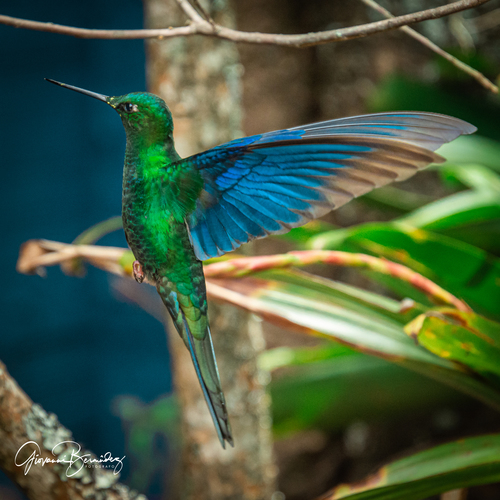
The great sapphirewing (Pterophanes cyanopterus) is one of the largest hummingbird species. Only the two species of the genus Topaza and the giant hummingbird (Patagona gigas) grow larger than it. Its total length including the bill is 15.5 to 19 cm (6.1 to 7.5 in), with the bill itself measuring 3.6 cm (1.4 in). Males weigh 9.6 to 11.2 g (0.34 to 0.40 oz), while females weigh 8.4 to 11 g (0.30 to 0.39 oz). Both sexes share the trait of having a small white spot behind the eye. For the nominate subspecies, males have dark, shining blue-green upperparts. Most of their wing is shining blue, their tail is greenish black, and their underparts are also blue-green, slightly bluer than their upperparts. Nominate subspecies females have mostly dark metallic green upperparts with a dusky gray crown. Only their wing coverts are blue, and the rest of the wing is dusky. Their tail is mostly greenish black with a large amount of white on the outermost feathers, and their underparts are cinnamon with green mixed in on the sides. Males of the subspecies P. c. caeruleus have more blue, and the blue is darker, than that of the nominate subspecies. Females of this subspecies also have more blue, a darker crown, and less white on the outer tail feathers. Males of P. c. peruvianus have upperparts that are more greenish than blue compared to the nominate subspecies, though their wings have roughly the same amount of blue. Their underparts are also greenish, with a buffy belly. Females of this subspecies have less intense cinnamon underparts than the nominate, and more white on the outer tail feathers. Regarding distribution and habitat, the nominate subspecies of great sapphirewing occurs in the Eastern Andes of Colombia, in the departments of Norte de Santander and Cundinamarca, and extends slightly into adjacent far western Venezuela. P. c. caeruleus is found in the Central and Western Andes of Colombia. P. c. peruvianus is the most widespread subspecies; it ranges from the Western Andes of Colombia southward through Ecuador and Peru to Cochabamba Department in central Bolivia. The great sapphirewing lives along the edges of humid evergreen forest and elfin forest, as well as on shrubby slopes with scattered trees. It also occurs well into páramo, at least on a seasonal basis. Its elevation range is 2,600 to 3,600 m (8,500 to 11,800 ft) in Colombia, 3,000 to 3,600 m (9,800 to 11,800 ft) in Ecuador, 2,600 to 3,700 m (8,500 to 12,100 ft) in Peru, and mostly above 3,000 m (9,800 ft) in Bolivia.