About Pteronura brasiliensis Zimmermann, 1780
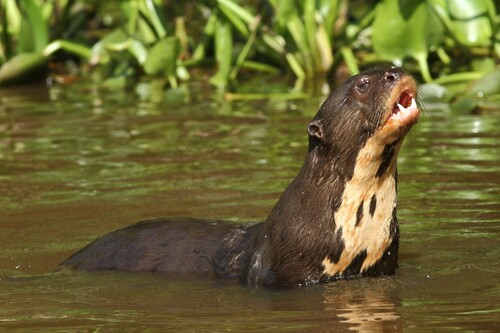
The giant otter (Pteronura brasiliensis Zimmermann, 1780) can be clearly told apart from other otter species by both its physical shape and behavior. It has the longest body of any species in the mustelid family, though sea otters may be heavier. Males measure 1.5 to 1.7 meters (4 feet 11 inches to 5 feet 7 inches) from head to tail, while females measure 1 to 1.5 meters (3 feet 3 and a half inches to 4 feet 11 inches). The species' well-muscled tail adds an extra 70 centimeters (28 inches) to total body length. Early reports from skins and living animals recorded exceptionally large males reaching up to 2.4 meters (7 feet 10 and a half inches); intensive hunting has likely reduced how often these very large specimens appear now. Male weights range from 26 to 32 kilograms (57 to 71 pounds), and female weights range from 22 to 26 kilograms (49 to 57 pounds). The giant otter has the shortest fur of all otter species. Its fur is typically chocolate brown, but may also be reddish or fawn, and looks nearly black when wet. The fur is extremely dense, enough that water cannot reach the skin. Guard hairs trap water to keep the inner fur dry; the guard hairs are around 8 millimeters (one-third of an inch) long, roughly twice as long as the inner coat fur. The fur's soft, velvety texture made giant otters highly desired by fur traders, and this demand contributed to the species' population decline. Individual giant otters can be identified from birth by unique white or cream fur markings on their throat and under the chin. Giant otters have short, sloping muzzles that give their heads a rounded, ball-like shape. Their ears are small and rounded. The nose (called the rhinarium) is completely covered in fur, with only two slit-shaped nostrils visible. The giant otter's highly sensitive whiskers (vibrissae) let it track changes in water pressure and currents, which helps it detect prey. Its legs are short and stubby, and end in large webbed feet tipped with sharp claws. Well-adapted for an aquatic lifestyle, giant otters can close their ears and nose when underwater. When Carter and Rosas wrote about the species, vision had not been directly studied, but field observations show giant otters primarily hunt by sight; above water, they can recognize observers from great distances. The fact that giant otters are only active during the day further suggests they have strong eyesight to support hunting and avoiding predators. In other otter species, vision is generally normal or slightly nearsighted (myopic), both on land and in water. The giant otter has acute hearing and an excellent sense of smell. This species has 2n = 38 chromosomes. The giant otter is amphibious, though it is primarily terrestrial. It lives in freshwater rivers and streams that generally flood seasonally. It also occupies other freshwater habitats including springs and permanent freshwater lakes. One ecologically important creek in Suriname hosts four specific vegetation types used by the species: riverbank high forest, floodable mixed marsh and high swamp forest, floodable low marsh forest, and grass islands and floating meadows within the creek's open areas. Duplaix identified two key factors that influence giant otter habitat selection: abundant food, which correlates positively with shallow water, and low-sloping banks with good cover and easy access to preferred water types. Giant otters tend to choose clear, black waters with rocky or sandy bottoms over silty, saline, and white waters. Giant otters use areas alongside rivers to build dens, campsites, and latrines. They clear large amounts of vegetation when constructing their campsites. One report recorded maximum campsite sizes of 28 meters (92 feet) long and 15 meters (49 feet) wide, which are clearly marked with scent gland secretions, urine, and feces to signal territory. Carter and Rosas found average campsite sizes were one third of this maximum. Giant otters create shared communal latrines next to their campsites, and dig dens with a small number of entrances, typically under root systems or fallen trees. One report found giant otter groups have between three and eight campsites, clustered near feeding areas. In seasonally flooded areas, giant otters may abandon their campsites during the wet season and disperse into flooded forests to search for prey. Giant otters may use preferred locations year-round, often on high ground. These perennial sites can become quite extensive, including "backdoor" exits that lead into forests and swamps away from the water. Giant otters do not visit or mark every site every day, but they usually patrol all of their sites, most often in pairs, in the morning. Most research on giant otter habitat use is conducted during the dry season, so the full picture of how the species uses habitat across the year remains incomplete. An analysis of dry season home range sizes for three giant otter groups in Ecuador found ranges between 0.45 and 2.79 square kilometers (0.17 and 1.08 square miles). Utreras estimated that habitat requirements and availability would differ greatly in the rainy season, projecting range sizes from 1.98 up to 19.55 square kilometers (0.76 to 7.55 square miles) for the studied groups. Other researchers have put the average home range size at around 7 square kilometers (2.7 square miles), and note a strong inverse relationship between sociality and home range size: the highly social giant otter has smaller home ranges than would be expected for a carnivore of its body mass. Population density varies across the species' range: a high of 1.2 otters per square kilometer (3.1 per square mile) was recorded in Suriname, while a low of 0.154 otters per square kilometer (0.40 per square mile) was found in Guyana. In 2021, conservationists with Fundación Rewilding spotted a wild giant otter swimming in the Bermejo River in Impenetrable National Park, located in the Chaco province of northeast Argentina. The giant otter has lost as much as 80 percent of its original South American range. While it still occurs in several north-central South American countries, giant otter populations are under significant threat. The IUCN lists Bolivia, Brazil, Colombia, Ecuador, French Guiana, Guyana, Paraguay, Peru, Suriname, and Venezuela as countries where the species is still found. Due to local extinctions, the species' current range is discontinuous. It is difficult to estimate the species' total global population. Populations in Bolivia were once widespread, but the country became a "black spot" on distribution maps after heavy poaching between the 1940s and 1970s; in 2002, a relatively healthy but still small population of 350 individuals was estimated to live in the country. The giant otter is likely extirpated from southern Brazil, but in western Brazil, reduced hunting pressure in the ecologically important Pantanal has led to very successful recolonization; estimates suggest 1,000 or more giant otters live in this region. As of 2020, the IUCN estimates there may be 4,569 giant otters living in Brazil. A large significant population lives in the wetlands of the central Araguaia River, particularly within Cantão State Park, which with its 843 oxbow lakes and extensive flooded forests and marshlands is one of the best remaining habitat patches for the species in Brazil. Suriname still has extensive forest cover and a large network of protected areas, much of which protects giant otter habitat. Duplaix returned to the country in 2000 and found giant otters were still present on Kaburi Creek, a biodiversity hotspot, though increased human presence and land use change means the species may eventually lose suitable habitat for campsites there. In a 2002 report for the World Wildlife Fund, Duplaix stressed the importance of Suriname and the other Guianas: the three Guianas remain the last stronghold of giant otters in South America, with undisturbed giant otter habitat on some rivers and good overall population densities—still, for how long? The survival of giant otter populations in the Guianas is critical to the long-term survival of this endangered species in South America. Other South American countries have taken leading action to designate protected areas for the species. In 2004, Peru created Alto Purús National Park, one of the largest conservation areas in the world, with an area similar in size to Belgium. The park is home to many endangered plants and animals, including the giant otter, and holds the world record for mammal diversity. In 2001, Bolivia designated wetlands larger than the size of Switzerland as a freshwater protected area, which is also home to the giant otter. Giant otters build dens, which are holes dug into riverbanks, usually with multiple entrances and multiple internal chambers. They give birth inside these dens during the dry season. In Cantão State Park, giant otters dig their reproductive dens on the shores of oxbow lakes starting around July, when water levels are already quite low. They give birth between August and September, and young pups emerge from the den for the first time in October and November, which are the months of lowest water when fish are concentrated in shrinking lakes and channels. This concentration makes it easier for adult otters to catch enough fish to feed growing pups, and for pups to learn how to catch fish themselves. The entire social group, including nonreproductive adults that are usually older siblings of that year's pups, works together to catch enough fish for the young. Details of giant otter reproduction and life cycle are limited, and much of what is known comes from study of captive animals. Females can give birth year-round, though wild births tend to peak during the dry season. The female estrous cycle is 21 days, with females receptive to mating between three and 10 days per cycle. Study of captive specimens has found only males initiate copulation. At Tierpark Hagenbeck in Germany, researchers observed long-term pair bonding and individual mate choice, with copulation occurring most often in water. Females have a gestation period of 65 to 70 days, and give birth to one to five pups, with an average of two. Five years of research on a breeding pair at the Cali Zoo in Colombia found the average interval between litters was six to seven months, but can be as short as 77 days when the previous litter does not survive. Other sources have recorded longer inter-litter intervals, with intervals of 21 to 33 months suggested for wild giant otters. Mothers give birth to cubs that are already covered in fur but blind, in underground dens near the river shore and fishing sites. Males actively participate in raising cubs, and family cohesion is strong; older juvenile siblings also help with rearing, though they may temporarily leave the group in the weeks immediately after birth. Pups open their eyes at four weeks old, begin walking at five weeks old, and can swim confidently between 12 and 14 weeks old. They are weaned by nine months old, and begin hunting successfully soon after weaning. Giant otters reach sexual maturity at around two years of age, and both male and female pups leave their natal group permanently after two to three years. They then search for new territory to start their own family groups. Studies of captive giant otters have identified key environmental conditions needed to maintain a physically and behaviorally healthy population and support successful cub rearing. These include meeting the minimum recommended land-to-water area ratio, and covering nearly all enclosure land surfaces (both artificial and natural) with the recommended substrate, such as tree-bark mulch and soft sand or soil that is free of pebbles. Ensuring giant otters have sufficient privacy from human disturbance (both visual and acoustic, from zoo staff or visitors) during birth and cub rearing is also essential, but not enough on its own. Historically, insufficient proportions of land area and unsuitable substrate conditions in zoos have been the main cause of high cub mortality and physical and behavioral health problems in captive giant otters. For example, stress to parent otters during cub rearing caused by inappropriate enclosure conditions has been the leading cause of cub neglect, abuse, and infanticide. In the wild, it has been suggested (though not systematically confirmed) that tourism causes similar stress, with risks including disrupted lactation and denning, reduced hunting success, and abandonment of habitat. This sensitivity to disturbance is paired with strong protectiveness toward young. All group members may aggressively charge intruders, including boats carrying humans. The longest confirmed lifespan of a wild giant otter is eight years. In captivity, lifespan can increase to 17 years, with an unconfirmed record of a 19-year-old individual. Giant otters are susceptible to a number of diseases, including canine parvovirus. They are also affected by parasites, such as fly larvae and various types of intestinal worms. Other recorded causes of death include accidents, gastroenteritis, infanticide, and epileptic seizures.