About Pteromys volans (Linnaeus, 1758)
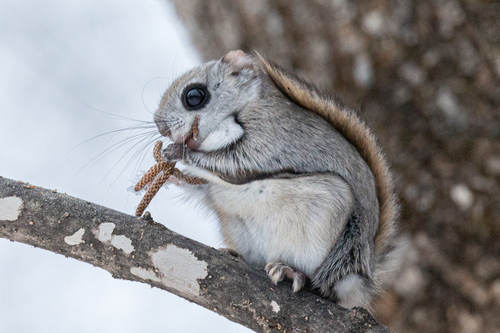
On average, female Siberian flying squirrels (Pteromys volans) weigh about 150 grams, while males are slightly smaller. Their bodies measure 13–20 cm in length, and they have a flattened tail that is 9–14 cm long. They have large, strikingly black eyes. Their coat is uniformly grey, with a slightly lighter abdomen and a black stripe running between the neck and forelimb. All flying squirrels share a distinctive feature: a furry glide membrane called a patagium, which is a flap of skin stretching between the front and rear legs. By spreading this membrane, Siberian flying squirrels can glide from tree to tree over distances of over one hundred meters. The maximum recorded glide ratio for this species is 3.31, but the normal glide ratio is between 1 and 1.5. The nominate subspecies P. v. volans is widespread across the Northern Palearctic, specifically ranging from Northern Europe through Siberia to East Asia. Other subspecies have limited ranges: P. v. athene is found on Sakhalin, P. v. buechneri is found in China, and P. v. orii is found in Hokkaido. Siberian flying squirrels favor old mixed forests that contain both conifers and deciduous trees. They are mostly nocturnal, and are most active late in the evening. An exception is females with young, which may also feed during the day. They do not hibernate, but in winter they may sometimes sleep continuously for several days. As they are shy and nocturnal, they are seldom seen. The most common sign of their presence is their droppings, which resemble orange-yellow rice grains and are often found beneath or on top of their nests. They mate early in spring. In southern Finland, the first mating season begins in late March, and a second mating season occurs in April. After a gestation period of five weeks, the female gives birth to a litter that usually contains two or three young. Each newborn weighs about 5 grams. The species preferentially builds nests in holes made by woodpeckers, but they will also nest in birdhouses if the entrance is the appropriate size. Their nest is a pile of soft materials, with soft beard lichen being preferred, that the squirrel burrows into. Siberian flying squirrels can live up to about five years.