About Pterois volitans (Linnaeus, 1758)
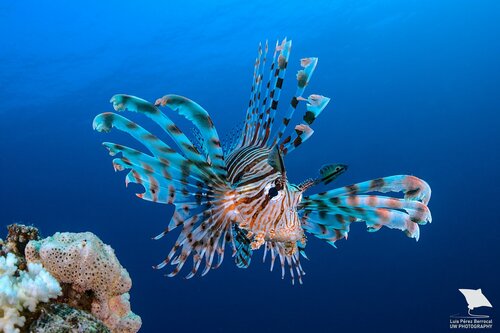
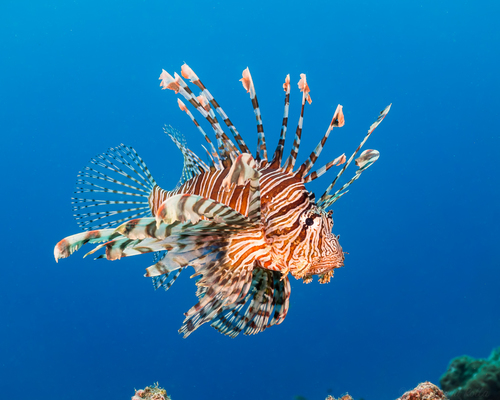
Pterois volitans, commonly known as the red lionfish, is a venomous coral reef fish that belongs to the family Scorpaenidae within the order Scorpaeniformes. It is primarily native to the Indo-Pacific region, including the western and central Pacific and the waters off the coast of western Australia. It has become an invasive species in the Caribbean Sea, along the East Coast of the United States, the East Mediterranean, the Western Atlantic, the northern Gulf of Mexico, and at Fernando de Noronha off Brazil. Both Pterois volitans and its close relative Pterois miles are classified as invasive species. Red lionfish have bodies covered in alternating white stripes and stripes of red, maroon, or brown. Adult red lionfish can reach a maximum length of 47 cm (18.5 in), making this species one of the largest lionfish species in the ocean, while juveniles are typically shorter than 1 inch (2.5 cm). The average lifespan of a red lionfish is around 10 years. Like many other species in the family Scorpaenidae, it has large venomous spines: 13 on its dorsal fin, 2 on its pelvic fins, and 3 on its anal fins. Combined with other long non-venomous fins, these structures create an appearance similar to a mane, which gives the fish its common name "lionfish". The venomous dorsal spines ward off most potential predators. No definitive predators of the red lionfish are currently known. Red lionfish are primarily solitary, and only aggregate during courtship, which usually involves one male and multiple females. Both P. volitans and P. miles are gonochoristic, and sexual dimorphism only appears during reproduction. All Pterois species share similar courtship behaviors, which include circling, sidewinding, following, and leading. Red lionfish are mostly nocturnal, so their courtship activities begin around nightfall and continue throughout the night. After courtship, the female releases two egg masses, which the male fertilizes before the masses float to the surface. Embryos are coated in an adhesive mucus that lets them attach to nearby intertidal rocks and corals before hatching. A female can lay up to 30,000 eggs in a single mating session, and females have been observed to lay more eggs during warmer months. Red lionfish reproduce monthly, and their larvae can disperse quickly to help the species expand its invasive range. To prevent further growth of already high invasive red lionfish population densities, many organizations promote the harvest and consumption of the species.