About Pterois russelii Bennett, 1831
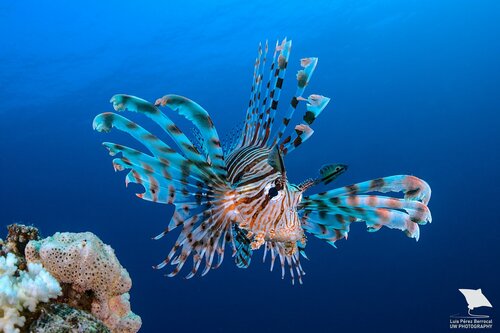
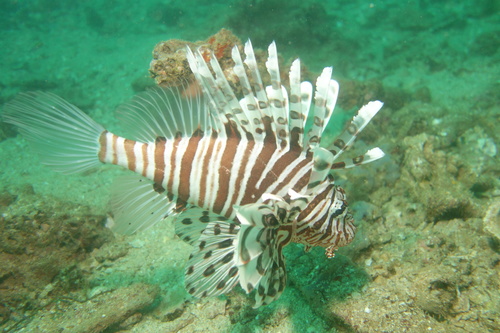
Pterois russelii, commonly known as Russell's lionfish, has 13 spines and 10 to 12 soft rays in its dorsal fin, and 3 spines with 7 or 8 soft rays in its anal fin. Its whitish body is marked with vertical reddish brown stripes. Unlike related species, this lionfish does not have rows of small dark spots on its soft dorsal, anal, and caudal fins, and it has comparatively short dorsal-fin spines. The maximum published standard length for this species is 30 cm (12 in).
Pterois russelii has a wide distribution across the Indo-Pacific region, ranging from the coast of eastern Africa as far south as South Africa, east from Oman to Japan and Australia. Its presence in the Red Sea was only confirmed in 2016. Within Australian waters, it occurs from Exmouth Gulf in Western Australia, along the northern tropical coasts to the Great Barrier Reef in Queensland. It can be found at depths between 15 and 60 m (49 to 197 ft), typically on muddy substrates in sheltered shallow estuaries, bays, and coastal waters, extending down to deeper waters on quiet offshore reefs.