About Pterogymnus laniarius (Valenciennes, 1830)
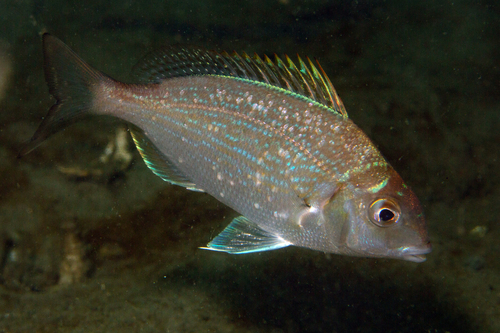
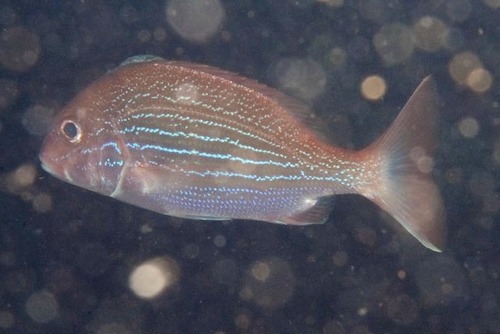
Pterogymnus laniarius, commonly known as panga, has scales covering the area between its eyes and the flange on its preoperculum. Its lower jaw holds two rows of molar-like teeth. The dorsal fin is structured with 12 spines and 10 soft rays, while the anal fin has 3 spines and 8 soft rays. A scaly sheath runs along the base of the soft-rayed portions of both the dorsal and anal fins, but there are no scales on the soft-rayed sections of these fins themselves. This species has a compressed, ovoid-shaped body, where body depth measures 2.3 to 2.5 times its standard length. The dorsal profile of the head is smoothly convex, and the eye is large. The rear edge of the preorbital bone has a wavy shape, and it is not covered by the scales of the cheek. The overall body color is red or pink, fading to a lighter shade on the lower body. There are 5 or 6 faint bluish horizontal lines running beneath the lateral line. This species reaches a maximum total length of 45 cm (18 in), with a more typical adult length of 27 cm (11 in). The panga is endemic to the coast of southern Africa, ranging from False Bay in the Western Cape of South Africa in the southeastern Atlantic Ocean to Beira, Mozambique in the southwestern Indian Ocean. It mostly lives on deep, topographically complex reefs, and is sometimes found over muddy or sandy areas at depths down to 120 m (390 ft).