About Pteroglossus pluricinctus Gould, 1836
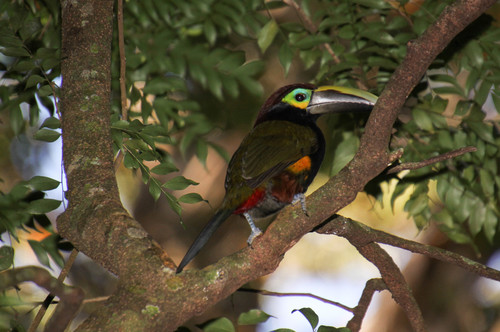
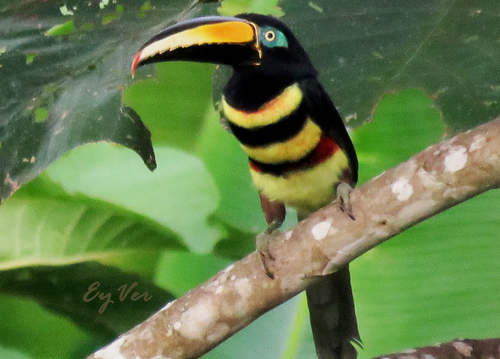
The many-banded aracari, with scientific name Pteroglossus pluricinctus Gould, 1836, measures 43 to 46 cm (17 to 18 in) in total length, which includes a bill that is 11 to 12.5 cm (4.3 to 4.9 in) long. The species weighs between 215 and 302 g (7.6 to 11 oz). Male and female bills share the same color pattern, but the female’s bill is shorter. A distinct orange-yellow line runs along the base of the bill. The maxilla is orange-yellow, with a wide black stripe along the culmen and a black base. The mandible is entirely black. Adult males have mostly black head, throat, and neck, except for bare blue-green to green skin surrounding the eye, and a chestnut patch behind the eye. Adult males have a dark green back, a red rump, and yellow underparts marked with two bands: the upper band is black, while the lower band is a mix of black and red. Their thighs have a mixed coloration of chestnut, green, and yellow. Adult females have little to no chestnut coloring behind the eye, and their black upper breast band is usually wider than that of adult males. Immature many-banded aracaris are duller in overall coloration than adults, particularly their yellow markings. Their bills are colored gray, brown, horn, and black, and lack the orange-yellow line at the base found on adult bills. Immatures have entirely green thighs. The many-banded aracari’s distribution stretches from northeastern Colombia and northwestern and southeastern Venezuela, south through eastern Ecuador to northeastern Peru, and east into northwestern Brazil north of the Amazon River, reaching as far east as Roraima state. The species primarily lives in terra firme forest; it occurs less commonly in várzea and gallery forests. It mostly lives at elevations up to 750 m (2,500 ft), though individuals can be found as high as 1,000 m (3,300 ft).