About Pteroglossus inscriptus Swainson, 1822
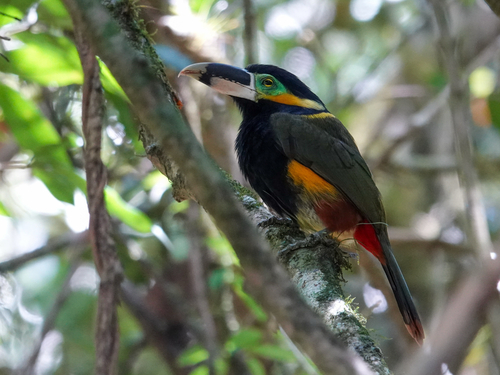
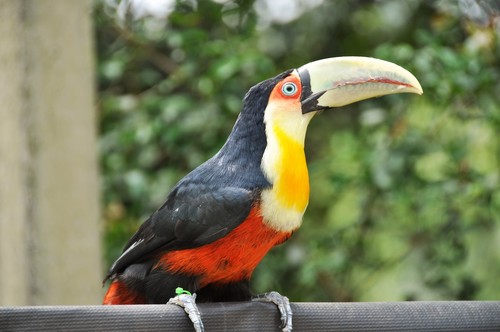
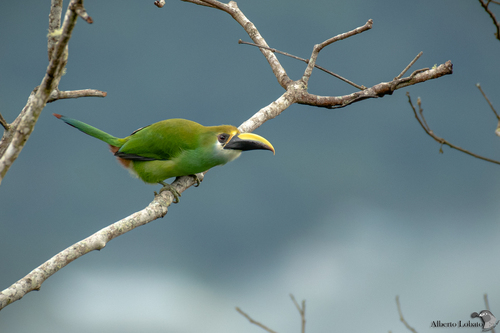
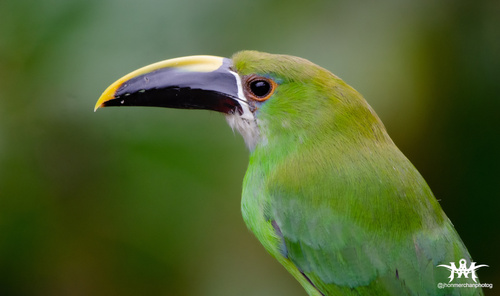
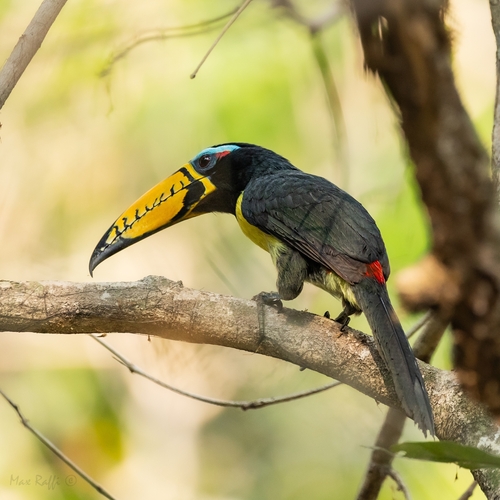
The lettered aracari (Pteroglossus inscriptus) is 33 to 35.5 cm (13 to 14 in) long. The nominate subspecies weighs approximately 100 to 130 g (3.5 to 4.6 oz), while subspecies P. i. humboldti weighs approximately 110 to 185 g (3.9 to 6.5 oz). For both subspecies, males are larger than females and have longer bills. All individuals have a complex patterned bill. The nominate subspecies has a mostly yellow maxilla, with a narrow black stripe along the culmen, a wide black tip, and a series of black "script" markings along its lower edge. Its mandible is pale yellow, with a wide black base and tip, plus a small number of black "script" markings near the tip. The maxilla of P. i. humboldti matches that of the nominate subspecies, but its mandible is almost entirely black. Nominate subspecies males have a black head, with the exception of bare blue, violet gray, and red skin around the eye. Their upperparts, wings, and tail are dark green except for a crimson rump. Their breast, belly, and undertail coverts are yellow, with pale buff cinnamon blotches. Their tibial feathers range from green to half green and half pale yellow. Nominate subspecies females have chestnut coloring on their throat and the sides of their head and neck, with a narrow black band below the chestnut on the throat. Immature lettered aracaris resemble paler versions of adult individuals. For both sexes of the subspecies P. i. humboldti, plumage is very similar to that of the nominate subspecies, except the tibial feathers are cinnamon or rufous. The nominate subspecies of lettered aracari occurs in north central Brazil, south of the Amazon River between the Madeira and Maranhão rivers, and extends south from this area to northern Bolivia, the Brazilian state of Mato Grosso, and the upper Tocantins River. A small separate population of the nominate subspecies lives in the far eastern Brazilian states of Pernambuco and Alagoas. Subspecies P. i. humboldti occurs in southern Colombia, eastern Ecuador, northwestern Bolivia, and western Brazil. In western Brazil it is found near the Amazon as far as the Negro River, and extends a short distance south beyond the upper Madeira River. (Note that distribution maps only show the range of the nominate subspecies.) The lettered aracari species inhabits a range of lowland evergreen forest types in the upper Amazon basin. These forest types include várzea, terra firme, secondary forest, gallery forest, and forested islands. In terms of elevation, it generally ranges up to about 500 m (1,600 ft), but can be found locally as high as 900 m (3,000 ft).