About Pteroglossus bitorquatus Vigors, 1826
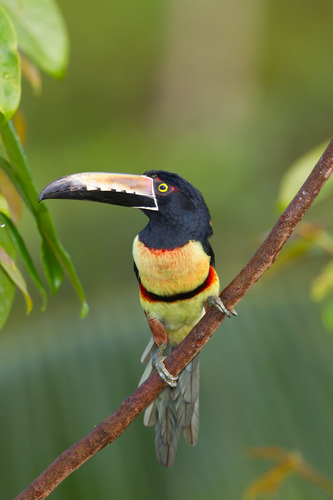
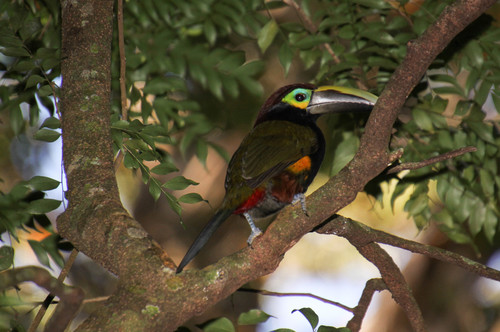
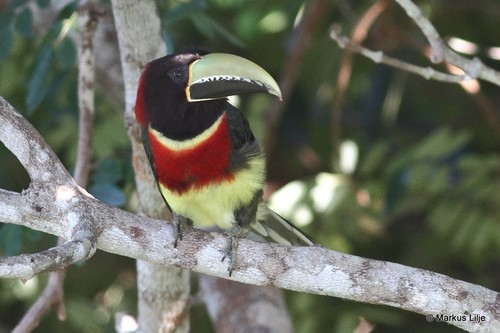
The red-necked aracari (Pteroglossus bitorquatus Vigors, 1826) is 36 to 40 cm (14 to 16 in) long and weighs 112 to 171 g (4.0 to 6.0 oz). For the nominate subspecies, the upper mandible (maxilla) is yellow to greenish white, with black and white markings along its edge that resemble teeth. The lower mandible has a white base that angles under the black color covering the rest of the mandible. Adult males have a blackish crown and dark brown face, chin, and throat. A patch of bare blue to greenish gray skin surrounds their eye. Their nape and breast are red; yellow and black bands separate the red breast from the throat. The rest of their upperparts are dark green, and their underparts are yellow below the breast. Adult females have a browner crown, a lighter face and throat, and a narrower yellow band above the breast compared to adult males. Immature red-necked aracaris are duller and browner than adults, and have orange coloration in the areas where adults are red. Subspecies P. b. reichenowi is similar to the nominate subspecies, but it has no yellow band above the breast, has less extensive red on the breast, and its bill has a jagged appearance near the base of the mandible where the black and white areas meet. Subspecies P. b. sturmii is larger than the nominate subspecies, has a wider yellow band above the red breast, has less apparent "teeth" markings on the maxilla, and its mandible is entirely black except for an orange-yellow band at its base and a pale tip. The three subspecies of red-necked aracari have distinct ranges: P. b. sturmii occurs in north-central Brazil south of the Amazon River, between the Rio Madeira and Rio Tapajós, extending south to Rondônia state and eastern Bolivia, and east to near the Rio Xingu; P. b. reichenowi occurs in Brazil south of the Amazon, between the Rio Tapajós and Rio Tocantins, extending south to northern Mato Grosso; P. b. bitorquatus (the nominate subspecies) occurs in northeastern Brazil south of the Amazon, from the Rio Tocantins east to the Atlantic coast in Maranhão state. The red-necked aracari lives in a variety of forest types from lowlands to hilly terrain. It occurs primarily in moist tropical terra firme forest, but also inhabits gallery forest in cerrado, dense bamboo stands, and mature secondary forest. It is found at elevations ranging from sea level to approximately 800 m (2,600 ft).