About Pteroglossus beauharnaisii Wagler, 1831
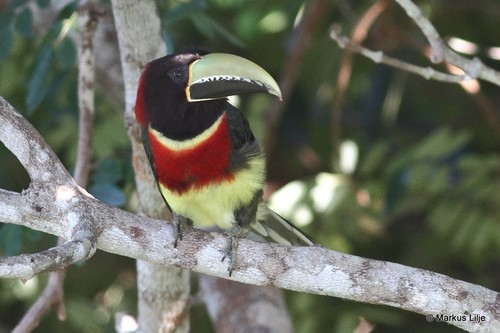
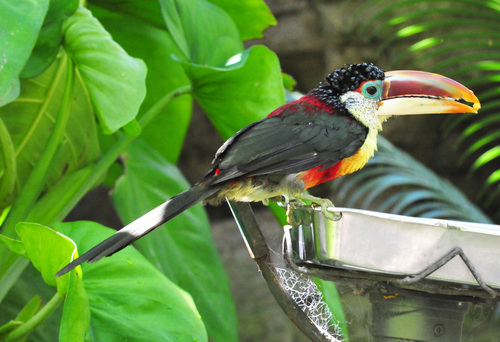
The curl-crested aracari, scientifically named Pteroglossus beauharnaisii Wagler, 1831, is 42 to 46 cm (17 to 18 in) long and weighs 164 to 280 g (5.8 to 9.9 oz). It gets its common English name from unique curly, shiny black feathers on the top of its head and nape, which resemble pieces of plastic or enamel. Males and females look similar, except the female has a shorter bill. The bill has a brown-orange line at its base. The lower mandible is ivory, turning orangey at the tip. The upper maxilla has an orangey culmen and a maroon stripe along its lower section that is wider at the base. The rest of the maxilla between these features is green or bluish. Indistinct ivory-colored "teeth" run along the bill's tomium. Bare blue skin surrounds the bird's eye, and its cheeks and throat are whitish with black speckles. Its upper back and rump are red, and the rest of its upperparts are dark green. Its underparts are yellow, with a wide red band across the lower breast. Its undertail coverts may have a red wash. Immature birds are duller versions of adults. The curl-crested aracari is distributed in the southwestern Amazon Basin, south of the Amazon River. Its range stretches from northern Peru south of the Marañón River east into western Brazil to the Madeira River, and southeast to the Xingu River. From Peru, the range also extends south into northern and central Bolivia, and into Brazil as far as northern Mato Grosso. This species lives in the interior, clearings, and edges of wet forest, including both well-drained and swampy forest. It mostly occurs at elevations below 500 m (1,600 ft), but has been found as high as 900 m (3,000 ft) near the Andes.