About Pteroglossus azara (Vieillot, 1819)
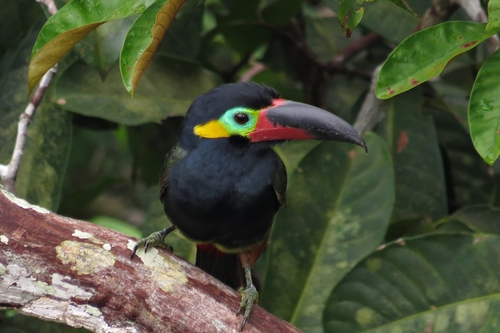
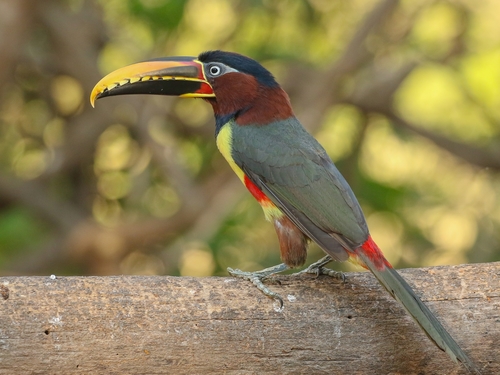
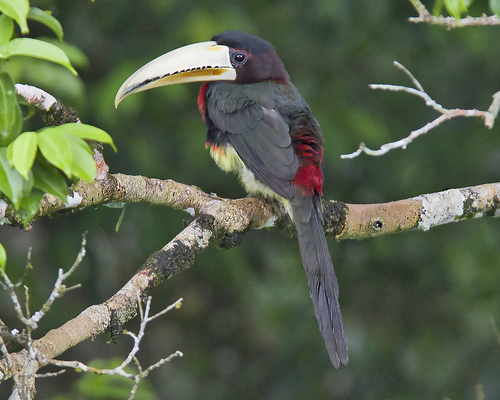
Ivory-billed aracari, scientifically named Pteroglossus azara (Vieillot, 1819), measures 36 to 45 cm (14 to 18 in) in length and weighs 120 to 160 g (4.2 to 5.6 oz). Its two subspecies do not differ noticeably in length, weight, or plumage, and only vary in bill color. Adult males have a black cap above a chestnut head and throat, maroon-red nape and upper back, green lower back, and red rump. They also have a narrow black band under the throat, a wide red band on the upper breast, a wide black band on the lower breast, a yellow belly, and green thighs. Adult females have a dark brown cap and a narrower black band below the throat than males. The bill of the nominate subspecies is mostly yellow, with a deep red to brown line on the maxilla that is broad at the base and tapers to a black tip. It has red, black, and ivory tooth-like markings along its edge. The bill of P. a. flavirostris has a yellow to ivory maxilla with an orange spot under the nostril, black and white tooth-like markings, and a yellow to ivory mandible with a narrow orange-brown line running down its middle. The nominate subspecies of ivory-billed aracari occurs in the Brazilian state of Amazonas, between the left bank of the Rio Solimões (upper Amazon) and the right bank of the Rio Negro. P. a. flavirostris is found in southeastern Colombia, southern Venezuela, eastern Ecuador, northeastern Peru, and northwestern Brazil, with some range overlap with the nominate subspecies. The species lives in a variety of forest landscapes including varzea, gallery forest, and secondary forest, and occurs less often in terra firme, bamboo, cloudforest, and plantations. It is more common in early- to mid-successional forest than in mature forest. In terms of elevation, it is mostly found below 600 m (2,000 ft), but is regularly found up to 900 m (3,000 ft), and occurs locally up to 600 m (2,000 ft) in the Ecuador-Bolivia border area. It is believed to be a year-round resident across its entire range. The ivory-billed aracari forages in the upper level and canopy of the forest, usually in pairs or small groups. Few details are known about its diet, but it appears to consist mostly of fruit with some arthropods.