About Pterocles senegallus (Linnaeus, 1771)
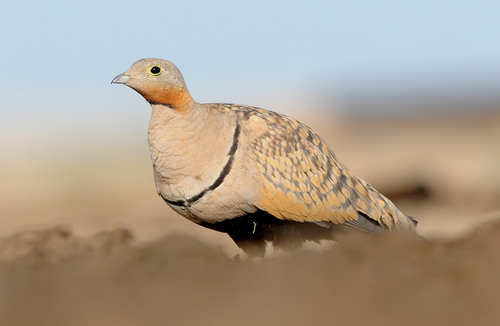
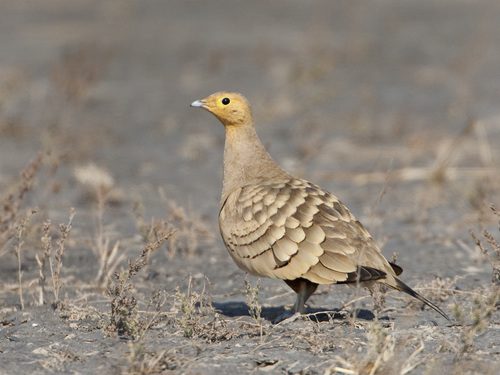
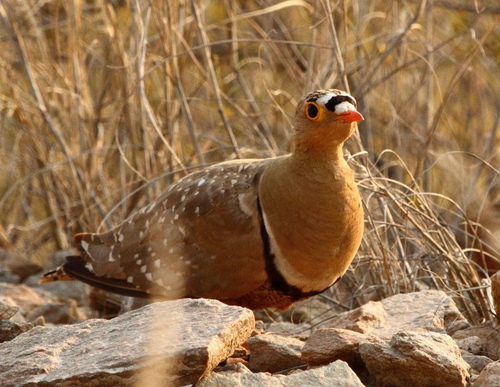
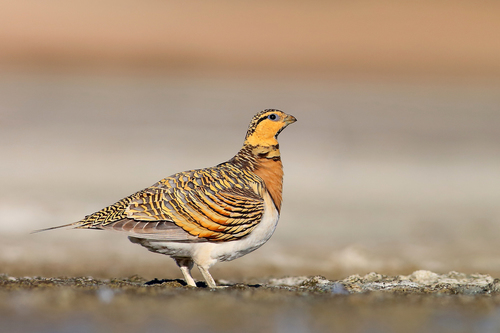
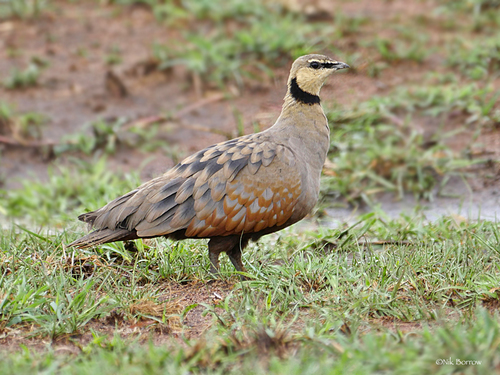
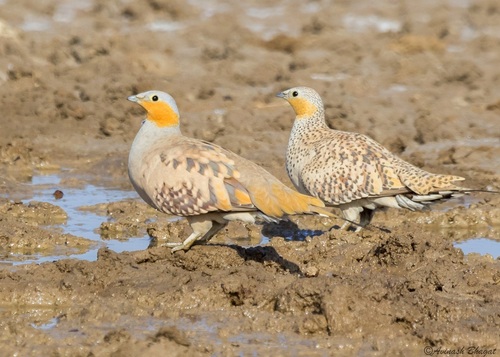
The spotted sandgrouse (Pterocles senegallus) reaches a length of about 33 centimetres (13 in). The male has a small reddish-brown nape, surrounded by a pale grey band that extends to the bill and forms a collar around the neck. The chin, neck and throat are orange, while the breast is grey. The upper parts of the body are pinkish-grey, with dark flight feathers and dark patches on the wings, tail and lower belly. The primaries are pale with dark trailing edges, a feature that distinguishes this species from the crowned sandgrouse (Pterocles coronatus), which has completely dark primaries. The female also has an orange throat, but its overall plumage is duller than the male's. The female's body is greyish-brown, liberally spotted with small dark markings, and also has dark patches on the wings, tail and lower belly. Central tail feathers are elongated in both sexes, but not to the same extent as they are in the pin-tailed sandgrouse (Pterocles alchata). When the bird flies overhead, a dark belly stripe is visible. The spotted sandgrouse is distributed across North Africa and the Middle East. In Africa, its range covers Morocco, Algeria, Tunisia, Libya, Sudan, Egypt, Eritrea, Somalia, Ethiopia, Djibouti, Mali, Mauritania, Chad and Niger. In the Middle East, it is native to Oman, Saudi Arabia, Israel, Jordan, Syria, Iran, Iraq and Afghanistan, and its range extends as far as Pakistan and north west India. In 2016, a flock of around a hundred birds arrived at Kutch after a 19-year absence. It has also been recorded as a vagrant in Italy, the United Arab Emirates and Turkey. It inhabits deserts and semi-arid countryside, and is largely resident, though flocks do make some local movements. The total population size has not been firmly confirmed, but the population appears to be stable, and the species is common across most of its extensive range. It is classified as least concern on the IUCN Red List of Threatened Species. In the Sahara, spotted sandgrouse breed during the hottest part of the summer on stony desert plains. Before selecting a nest site, the female scrapes several trial hollows. The main selection criterion appears to be the porous nature of the underlying rock: spongy porous rock heats up less in the sun, providing a cooler nesting spot. It is also desirable to have one or two "cover stones" nearby; these dense stones attract dew at night, and the moisture drains into the soil and is absorbed by the porous rock, helping to keep the nest cool during the day. The nest is a shallow ground depression with no added bedding material. Two, or occasionally three, eggs are laid. The eggs are elongated ovals, buff-colored with grey and brown blotches and speckles. This color and shape makes them hard to distinguish from the pebbles surrounding the nest. Both parents incubate the eggs, and their cryptic coloration makes them almost invisible when sitting on the nest. Eggs hatch after approximately 20 days. The young are precocial, and are already covered in down when they emerge from the eggs. Soon after hatching, the female leads the chicks to one of the many wadis that cross the plains, where she teaches them to peck at and eat seeds. The chicks take four or five weeks to fledge and become able to fly. The need to supply the chicks with water is met by the male, who has specially adapted absorbent belly down. The male immerses himself in water at a waterhole to saturate his plumage, absorbing enough water to sustain the chicks until the next day. As he leaves the waterhole with water-saturated feathers, the male gives repeated high-pitched "queet - queet - queet" calls. When the female and chicks hear his approach, they call back, allowing the male to locate his family even if they have moved away from the nest. On arrival, he stands upright and raises his wings to display his wet belly feathers, which signals the chicks to approach, stand under him with upturned beaks, and suck the moisture from between his feathers. If danger is present, chicks crouch under plants or any available cover, and their dappled brown down blends into the desert landscape. Parents are very vigilant when defending their family. If a jackal approaches, an adult gives a warning cry, and all individuals crouch and freeze. The intruder usually does not notice them and passes by. If the jackal gets too close, one parent will attempt to lure it away by flapping along the ground, pretending to be injured and helpless. Once the jackal has been led far enough away, the parent recovers and flies off. After three or four days, the chicks can be left alone while both parents visit the waterhole, and the chicks can guide their parents back with their own "queet - queet" calls.