About Pterocles namaqua (Gmelin, 1789)
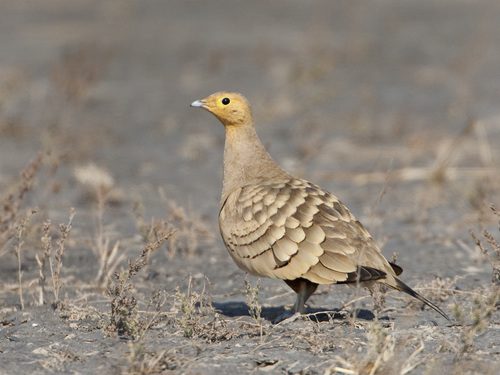
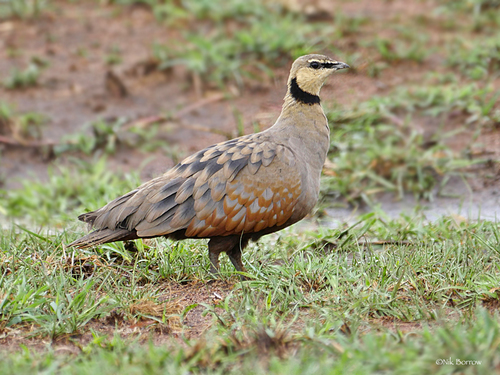
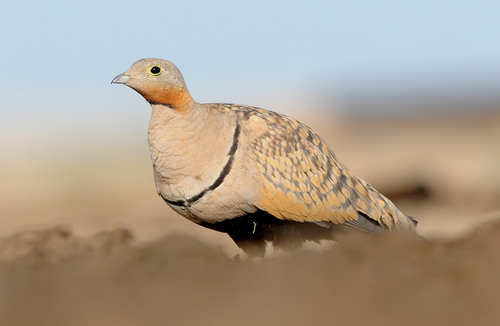
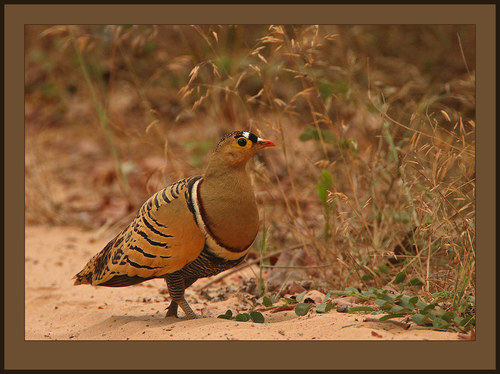
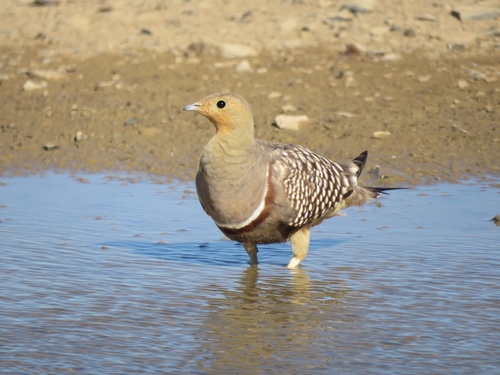
Namaqua sandgrouse, scientifically named Pterocles namaqua, is a medium-sized bird with a plump body, small head, and short legs. It reaches an adult length of roughly 28 centimetres (11 inches). Males have orangish buff on the head, throat, and chest, which is marked off by a noticeable narrow band of white and dark brown. The back and wings are mottled brown with large white specks, and two long black filaments extend from the olive-brown tail. Females and juveniles have more camouflaged coloration, generally consisting of various shades of brown patterned with white specks. This species shares its range with the double-banded sandgrouse (Pterocles bicinctus) and Burchell's sandgrouse (Pterocles burchelli), and can be mistaken for either of these two species.
This sandgrouse occurs across multiple arid regions of South Africa and surrounding countries. It is common in the Kalahari Desert, the Nama Karoo of central and western South Africa, and parts of the Western Cape. It can also be found in Namibia, particularly in the Namib Desert, as well as in Zimbabwe, Botswana, and Angola. It prefers deserts and other arid habitats. To survive, it only requires seeds, some gravel, and ready access to a source of fresh water. Its typical habitat contains sparse rough vegetation and tussock-type grasses.