About Pterocles decoratus Cabanis, 1868
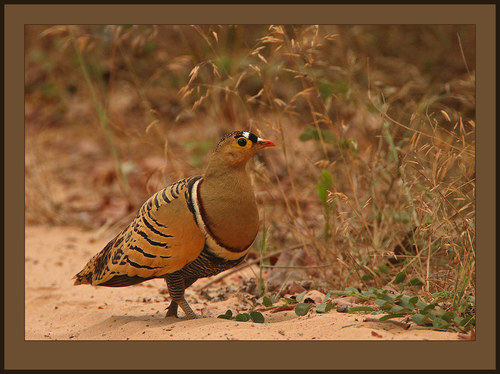
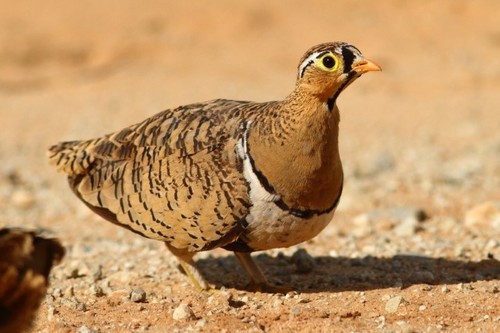
The black-faced sandgrouse, scientifically named Pterocles decoratus Cabanis, 1868, is a medium-sized bird that measures approximately 28 cm (11 in) long and weighs between 140 and 210 g (4.9 and 7.4 oz). It has an overall small, compact body, a short tail, pointed wings, and short feathered legs. Its wing tips are black when the bird is in flight. As its common name suggests, males are easily identified by black face markings that run from the forehead down to the throat. Males also have distinct black and white eyebrow stripes above each eye, a pinkish-orange bill, and a yellow eye-ring that contrasts against their black facial plumage. Their chest is pale brown, with a thin bold black stripe followed by a thick white stripe on the breast, and a dark belly. Females do not have the black mask seen in males. Their face is pale brown with a white eyebrow above the eye, a yellow eye-ring, and a greyish bill. Their overall body color is pale brown, with blackish barring and streaking across the chest, wings, and back. Like males, females have a dark belly and the same black and white breast stripe pattern found on males. Females can be confused with other sandgrouse species, but they can be distinguished by their small size and white breast mark. Juveniles look similar to females, but have darker barring on the back. This species occurs in East Africa, in the dry zones of Ethiopia, Kenya, Tanzania, Uganda, and Somalia. It is frequent in Ethiopia, common and widespread in southern Somalia, and locally common in Kenya. The black-faced sandgrouse lives in dry, open habitats that are typical of East Africa's savanna landscape, including dry savanna, bushveld, and semi-desert scrub. It is occasionally found in dense thornbush, particularly in open areas such as roadsides. Its altitude range extends from sea level up to 1,600 m. All sandgrouse are monogamous. For sandgrouse living in semi-arid tropics, the breeding season aligns with rainfall, so the exact timing and scope of the breeding season is highly unpredictable. In Kenya, there are two main breeding seasons: one from January to March, which overlaps with the short hot dry period, and another from July to October, which coincides with the long cool dry season. Black-faced sandgrouse are also known to breed when seeds are most abundant, which is generally four to six months after rainfall. In Tanzania, breeding takes place from May to November or December, with a breeding peak in the dry season between June and August. Even though little is documented about the species' overall breeding patterns, it is known that their reproductive organs grow significantly larger during the breeding season. Females incubate eggs during the day, and males take over incubation at night. This schedule leaves males with less time for foraging, leading to a higher water deficit during incubation, so incubating females visit waterholes more often than incubating males do. After the chicks hatch, males spend more time guarding the young, which reduces their own foraging time. Black-faced sandgrouse build an unlined scrape nest: they create a small depression in the soil by scraping sand away. Females lay 2 to 3 eggs. Once hatched, the chicks are sandy or golden in color with grey and black streaks.