About Pterocles burchelli W.L.Sclater, 1922
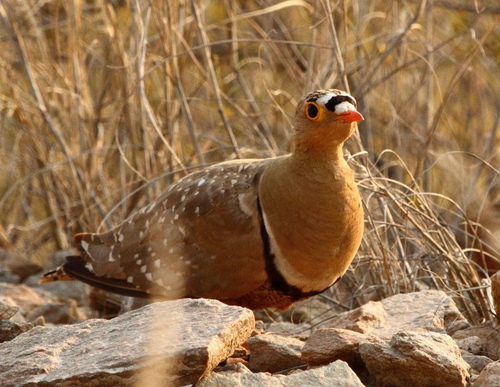
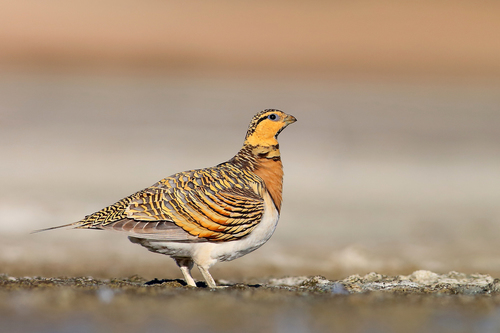
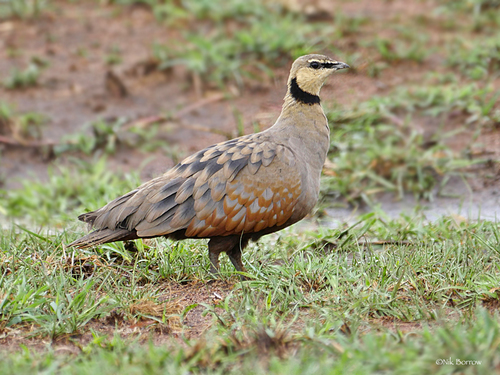
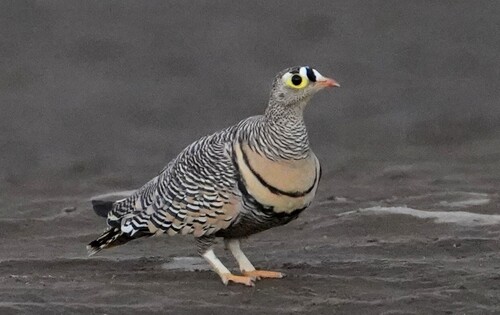
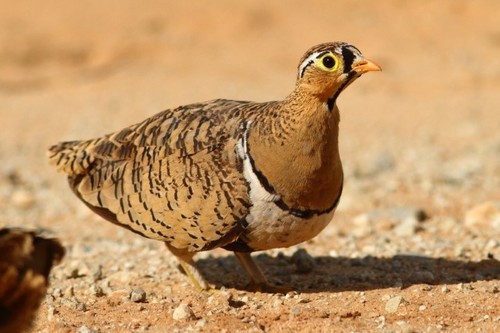
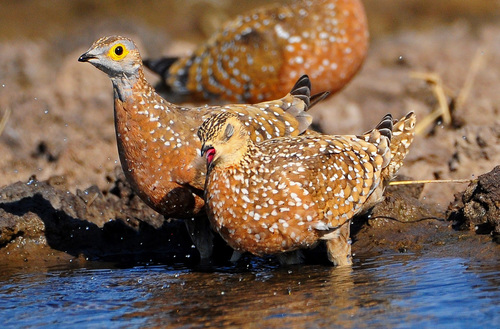
Burchell's sandgrouse is a plump bird roughly the size of a pigeon, with a small head and short legs. Its body is light brown, mottled with darker shades and marked by white speckles. Males have bare yellow skin surrounding the eye, and pale grey cheeks and throat. Males grow to around 25 cm (10 in) long, and females are slightly smaller. Like many species that live in desert environments, Burchell's sandgrouse is limited by water availability. When temperatures approach the upper critical limit of their thermal neutral zone, around 43.8°C, adult sandgrouse increase gular fluttering and panting to achieve evaporative cooling. Another adaptation adult Burchell's sandgrouse have developed is carrying water in their body feathers from a water source back to the nest to give water to their chicks. When they arrive at a water source, adult Burchell's sandgrouse first rub their bellies on dry ground to ruffle their belly feathers, which increases the amount of water the feathers can hold. They then wade into the water and bob up and down to soak water into their belly feathers. On average, males have been observed holding 22 ml of water, while females can carry an average of 9 ml. After gathering the water, Burchell's sandgrouse fly back to the nest and let their chicks drink water from their belly feathers. Burchell's sandgrouse is found in Angola, Namibia, Botswana, Zambia, Zimbabwe, and South Africa. It is widespread and common across most of its range. It is normally resident, but moves over a limited area based on the availability of water and the seeds it primarily eats. It often lives in areas of rough grass and scrub, especially on red Kalahari sand, and has been able to extend its range because sinking boreholes by farmers has made more water available.