About Pterocles bicinctus Temminck, 1815
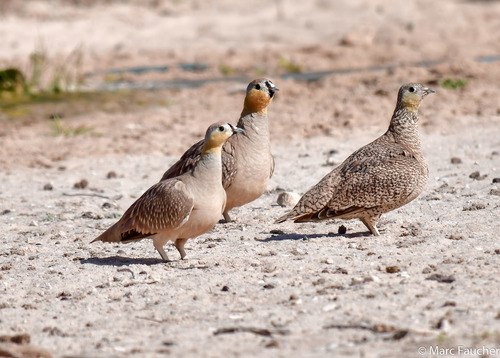
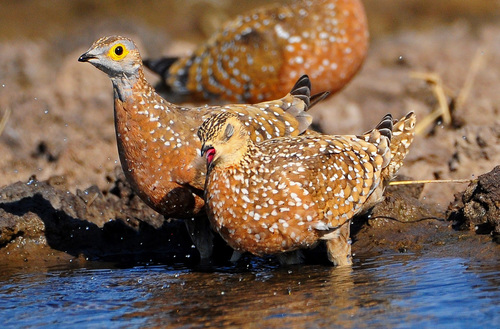
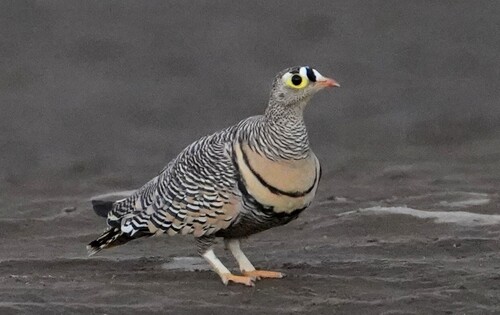
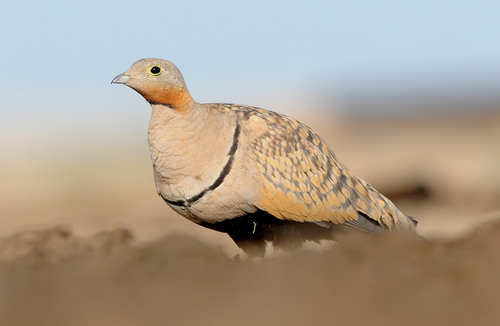
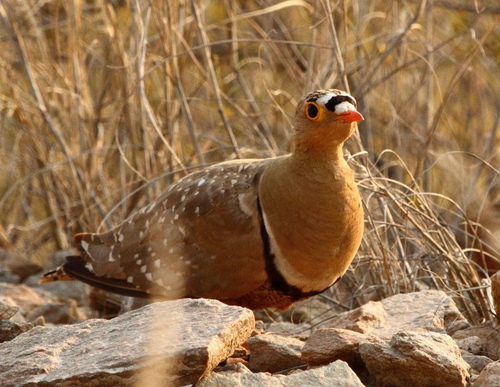
The double-banded sandgrouse (scientific name Pterocles bicinctus Temminck, 1815) is a moderately-sized bird with a quail-like build and a plump body. It has a small head similar to that of a pigeon, paired with long wings and a long tail. Its overall plumage is light brown, marked with darker mottling and rows of whitish specks. Males can be identified by a prominent black-and-white band on the forehead, and a chestnut throat that is outlined by another black-and-white band. Both males and females have a patch of bare yellow skin surrounding the eye socket, and males have an orange beak. Females are smaller and have duller brown plumage than males. Juvenile double-banded sandgrouse look similar to adult females. This species occurs in Angola, Botswana, Malawi, Mozambique, Namibia, South Africa, Zambia and Zimbabwe. It favours specific habitats: short trampled grass alongside roads and tracks, gravel patches, tussocky grassland, and recently burned scrub areas where new green shoots are starting to grow. It can also be found in areas with sparse vegetation beneath scattered Terminalia sericea and Burkea africana trees, and in scrubby mopane woodland. It is less common than Burchell's sandgrouse (Pterocles burchelli) and Namaqua sandgrouse (Pterocles namaqua), both of which share an overlapping range with it in southern Africa.