About Pterocelastrus echinatus N.E.Br.
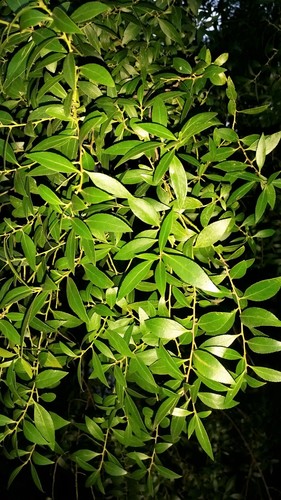
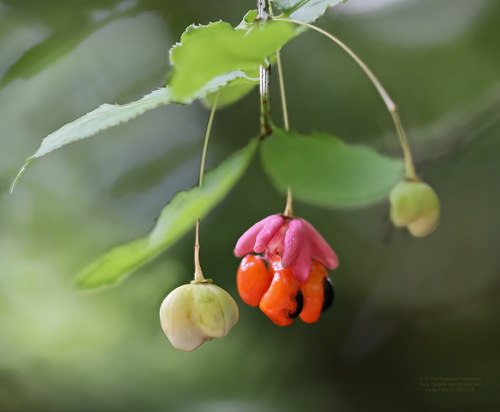
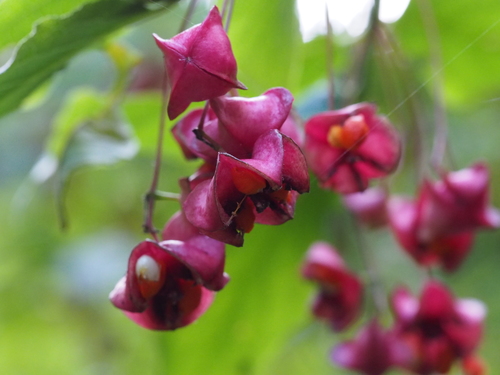
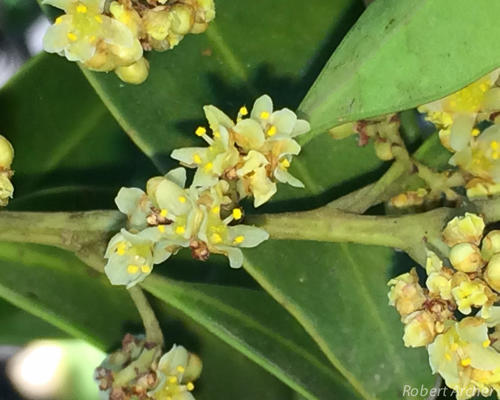
Pterocelastrus echinatus, whose scientific name translates to "spiny winged holly", is a shrub or small tree native to Southern Africa. It grows in South Africa, Mozambique, Zimbabwe, Eswatini, and Malawi, and occurs in montane and submontane evergreen forests, forest margins, rocky hillsides, and kloofs at elevations between 600 and 2400 m above sea level. It is also commonly known as white cherrywood or witkersiehout. This species has pale grey bark, with bright orange underbark on young angular shoots. Its leaves are spirally arranged, entire, glabrous, elliptic to lanceolate, somewhat leathery and glossy. Leaves are dark green on the upper surface and paler below, with often revolute margins. Petioles can grow up to 8 mm long, and often have a wine-red colour that extends into the leaf midrib. Its small, fragrant flowers are white to cream, and grow in axillary clusters. The fruit is a three-celled woody dehiscent capsule 6–8 mm long, which turns yellow to orange to red when mature. Each valve of the capsule has one to three bluntly pointed to winglike protuberances, and each seed is almost entirely enveloped by an aril. This species was first formally described by the taxonomist N. E. Brown from Kew Gardens in 1906, with the publication appearing in the Bulletin of Miscellaneous Information Kew on page 16. Resin produced from the wood and roots of this tree was used by Bantu tribes to attach spear heads to their shafts. The attractive wood of Pterocelastrus echinatus is pink to red in colour, dense and moderately durable, and resembles the wood of European cherry (Prunus avium). In the past, this wood was used in wagon-building for pivot-plates (schamels) and spokes, and it is suitable for turnery and cabinet-making. This tree is a host species for four moth species in the family Geometridae: Aphilopota patulata, Aphilopota subalbata, Drepanogynis costipicta, and Drepanogynis olearis.