About Pterocarpus indicus Willd.
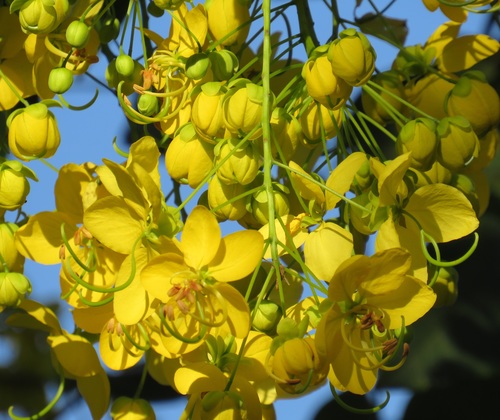
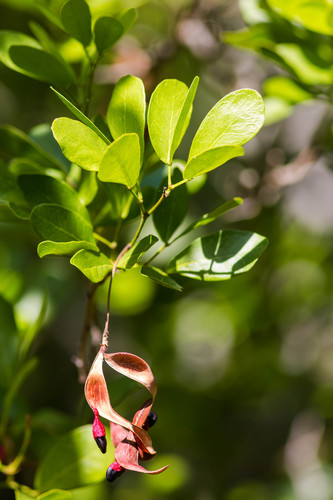
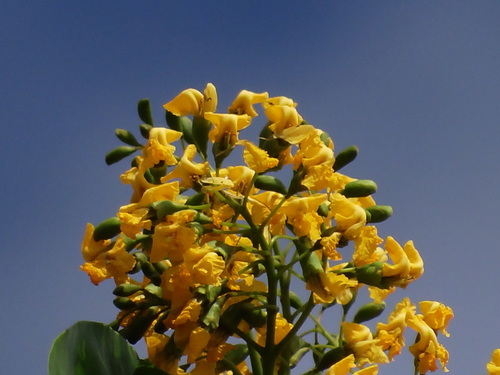
Pterocarpus indicus Willd. is a large deciduous tree that reaches 30–40 m in height, with a trunk up to 2 m in diameter and a crown 12–34 m wide. Its leaves are 12–22 cm long, pinnate, and bear 5–11 leaflets. While most Pterocarpus species prefer seasonal weather, P. indicus prefers rainforests. It produces flowers in panicles 6–13 cm long that hold anywhere from a few to numerous flowers; flowering occurs from February to May in the Philippines, Borneo, and the Malay peninsula. The flowers are slightly fragrant, with yellow or orange-yellow petals. Its fruit is a semiorbicular pod 2–3 cm in diameter, surrounded by a flat membranaceous wing 4–6 cm in diameter that aids wind dispersal. The pod holds one or two seeds, does not split open when mature, takes 4–6 years to ripen, and turns purple when dry. The central part of the pod can be smooth (form indica), bristly (form echinatus (Pers.) Rojo), or intermediate in texture. Note: Pterocarpus macrocarpus, a similar species native to Burma, is called "Rosewood" across southeast Asia. P. macrocarpus is usually harder than P. indicus, and when found in burl form, both species are called "Amboyna burl". The tree's purplish hardwood is termite-resistant and rose-scented. In Indonesia, the tree's burl wood is known as amboyna, named after Ambon where most of this material was originally sourced. Amboyna is often finely sliced to create an extremely decorative veneer, used for decoration, furniture, and marimba keys. It is a premium timber species suited for high grade furniture, general timber, and plywood for light construction. It is also used for cartwheels, wood carving, and musical instruments. Its flowers are a source of honey, while leaf infusions are used as shampoos. Both flowers and leaves have been reported to be eaten. The leaves are said to work well for waxing and polishing brass and copper. The tree is also a source of kino, or resin. Narra leaves are used in traditional medicine to treat a range of health problems, and contain flavonoids, antioxidants that provide anti-inflammatory and anti-allergic health benefits to humans. Flavonoids in narra leaves may be capable of preventing kidney damage. In folk medicine, the tree is used to combat tumours; this potential property may come from an acidic polypeptide found in its leaves that inhibits the growth of Ehrlich ascites carcinoma cells by disrupting cell and nuclear membranes. It was also one of the sources of lignum nephriticum, a diuretic used in Europe from the 16th to 18th centuries, whose reputation comes from its fluorescent wood infusions. The tree is recommended as an ornamental avenue tree, and is sometimes planted in Puerto Rico for shade and as an ornamental. It has an attractive tall, dome-shaped crown with long drooping branches, and produces spectacular blooms in areas with a dry season. It propagates very easily from seed or large stem cuttings, but is prone to disease problems. It is widely planted as a roadside, park, and car park tree. In agroforestry, it maintains ecosystem fertility and soil stability. As a leguminous plant, it can fix nitrogen by forming endosymbiotic relationships with nitrogen-fixing bacteria that live in its root nodules, allowing it to convert atmospheric nitrogen into a form plants can use. In the Philippines, a permit is required to cut the Narra tree (called Nára in Tagalog and Cebuano, Nara in Maranao), even though this popular sturdy wood is widely used for construction and furniture projects. In Singapore, its easy propagation made it a favourite for urban planners, who planted it in monoculture during a 1969–1982 campaign to turn the rapidly growing city into a "green" city. In 1985, 1,400 trees died from Angsana Wilt Disease and were cut down; the cause was identified as the fungal species Fusarium oxysporum, carried by wood-boring ambrosia beetles that bore into the trees. The infection was eventually controlled through a combination of monitoring, removal of lightning-damaged trees, and replanting with confirmed disease-resistant varieties.