About Pterocaesio tile (Cuvier, 1830)
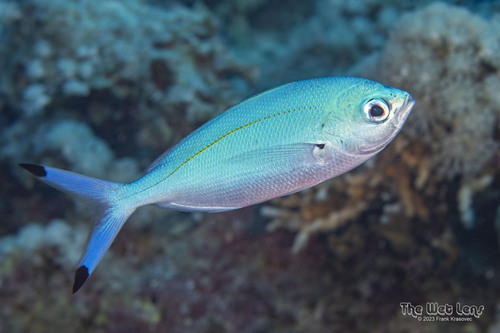
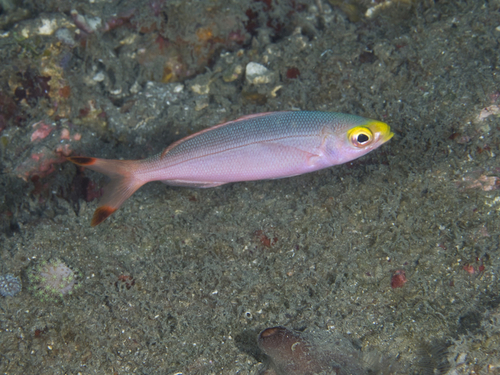
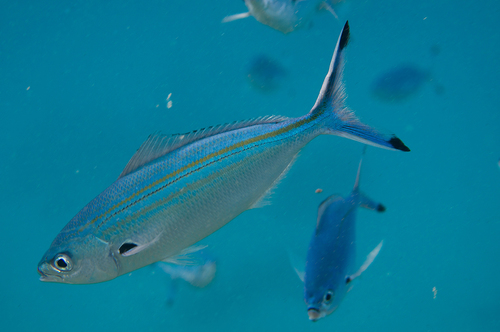
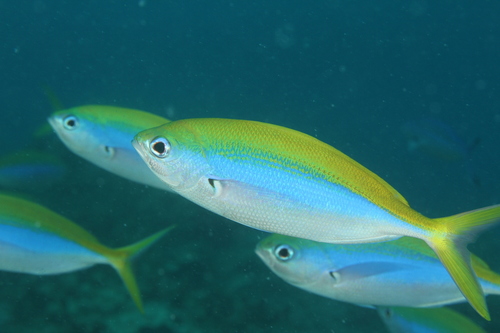
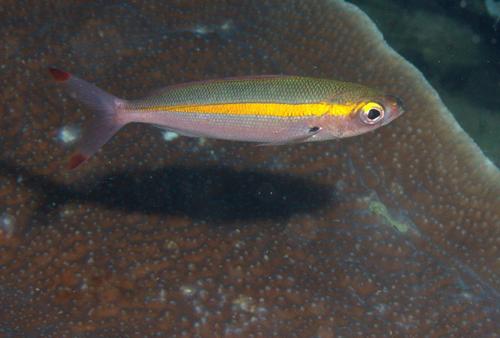
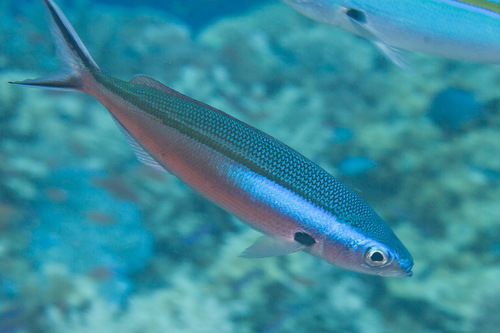
Pterocaesio tile, commonly called the dark banded fusilier, has an elongated, compressed fusiform body. Small conical teeth are present on the jaws, vomer, and palatines. Its dorsal fin has 10–12 spines and 19–22 soft rays, while the anal fin has 3 spines and 13 soft rays; both the dorsal and anal fins bear scales. The pectoral fins have 22–24 rays. This species reaches a maximum total length of 30 cm (12 in), with a more typical standard length of 21.2 cm (8.3 in). Its overall base colour is brownish, and each scale on its back has a white spot that forms distinct rows. The lower body ranges from pink to reddish. A wide iridescent blue stripe runs from the snout to the caudal peduncle; this stripe is edged above by a thin black stripe that extends onto the upper lobe of the caudal fin. There is a black spot at the base of the pectoral fin. This species can change colour quickly, darkening the lower body to a reddish shade and shortening the blue stripe. The dorsal fin is pale bluish-green to pinkish, and there is a black streak in the lower lobe of the caudal fin, which is separate from the black lateral stripe that extends onto the upper lobe. The dark-banded fusilier is widespread across the Indo-Pacific, ranging from East Africa to the Tuamoto Islands, southern Japan, Mauritius, and the Austral Islands. In Australian waters, it occurs at the Rowley Shoals off Western Australia, Ashmore Reef in the Timor Sea, the far northern Great Barrier Reef, reefs in the Coral Sea extending to the Solitary Islands in New South Wales, and at Christmas Island and the Cocos (Keeling) Islands. This is a coral reef-associated species, most commonly found in lagoons and on reef flats at depths up to 60 m (200 ft).