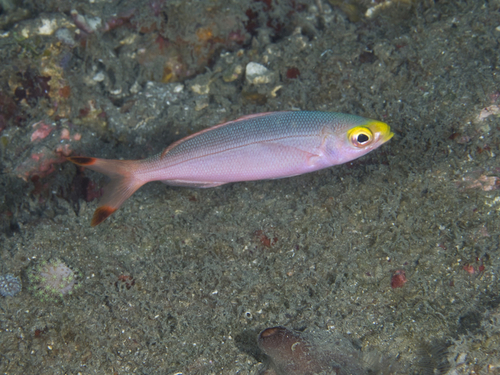
About Pterocaesio pisang (Bleeker, 1853)
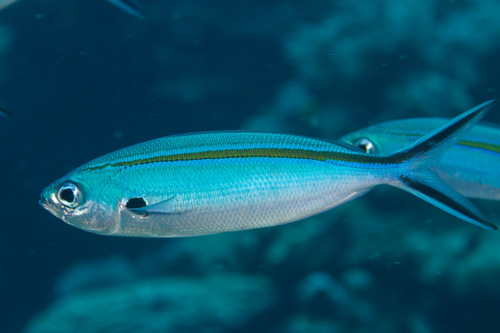
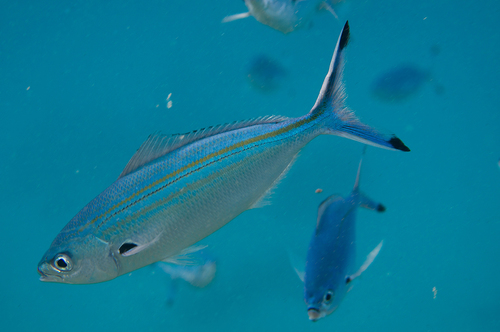
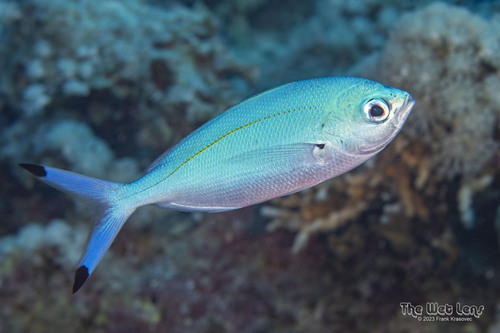
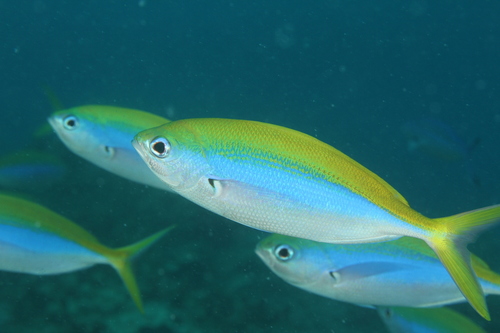
Pterocaesio pisang, commonly called the banana fusilier, has a fusiform, elongated body that is moderately compressed from side to side. Small conical teeth are present in its jaws, as well as on the vomer and palatines. Its dorsal fin has 10–11 spines and 14–16 soft rays, while the anal fin has 3 spines and 11–13 soft rays. Both the dorsal and anal fins bear scales, and the pectoral fins have 18–20 rays. This species reaches a maximum total length of 21 cm (8.3 in). It has a yellowish snout and upper portion of the eye, with greyish-blue back and upper flanks that shade to pink on the lower flanks and belly. The tips of its caudal fin lobes are dark red. It has no stripes along its flanks, but does have a distinct black lateral line. This species has a wide distribution across the Indo-Pacific region. It occurs along the East African coast from southern Somalia to Mozambique, and has an apparently isolated population around Socotra. It is not found in the Red Sea or the Persian Gulf. In the Pacific, its range extends east to Fiji, north to the Ryukyu Islands, and south to Australia. In Australia, it is found at Scott Reef in Western Australia, Ashmore Reef in the Timor Sea, and along the northern Great Barrier Reef as far south as the waters off Tully, Queensland. It lives at depths between 1 and 100 m (3 ft 3 in and 328 ft 1 in), but is most frequently found at depths shallower than 30 m (98 ft). It occurs around coastal reefs, lagoon reefs, and seaward reefs.