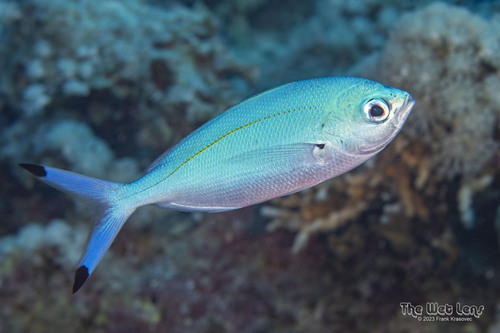
About Pterocaesio digramma (Bleeker, 1864)
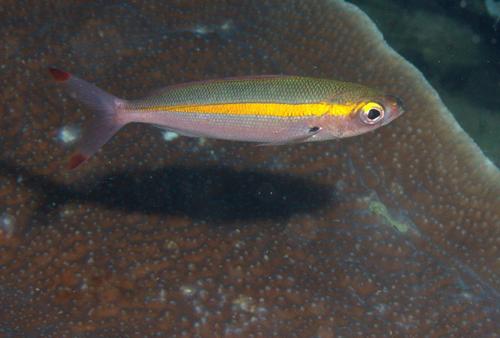
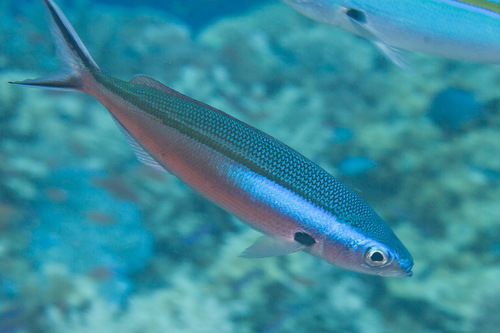
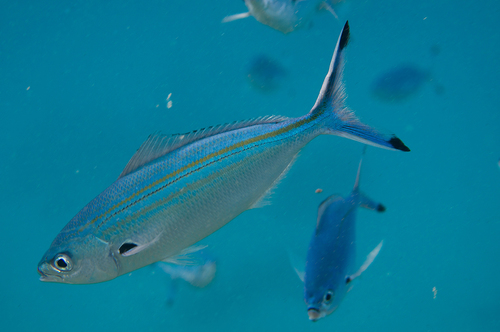
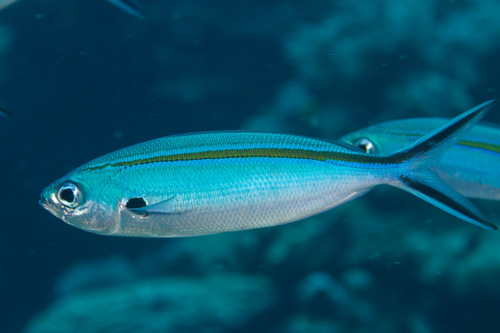
This species is commonly called the double-lined fusilier, with the scientific name Pterocaesio digramma (Bleeker, 1864). It has a fusiform, elongated body that is moderately laterally compressed. Small conical teeth are present in the jaws, as well as on the vomer and palatines. Its dorsal fin has 10 spines and 14–16 soft rays, while the anal fin has 3 spines and 11–12 soft rays. Both the dorsal and anal fins have scales, and the pectoral fins have 20–22 rays. This species reaches a maximum total length of 30 cm (12 in). Its overall body colour is bluish-green, lightening toward the lower body. A pair of slender yellow stripes run along the back and the middle of the flank; the more ventral yellow stripe is mostly located underneath the lateral line, except for the portion that sits on the caudal peduncle. The lobes of the caudal fin have dark tips. The double-lined fusilier is found in the Western Pacific Ocean, ranging from Indonesia, Western Australia and New Caledonia to southern Japan. It has also been recorded off Norfolk Island and in Tonga. The reported record of this species from Réunion is likely a misidentification of Pterocaesio marri. It inhabits coastal waters down to depths of 50 m (160 ft), and occurs mainly around coral reefs. Along with other fusilier species, the double-lined fusilier is commonly eaten in Japan, where it is called takasago (タカサゴ). In the Okinawan language it is known as gurukun (グルクン), it is the designated prefectural fish of Okinawa, and it is very common in Okinawan cuisine. The most common way it is served is deep-fried as kara-age. In English, this species is sometimes referred to as "banana fish", though this name may also refer to other related species such as Pterocaesio pisang.