About Pterocaesio chrysozona (Cuvier, 1830)
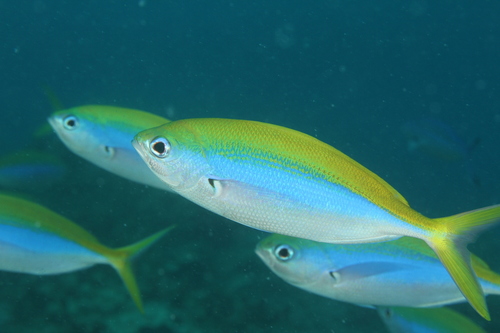
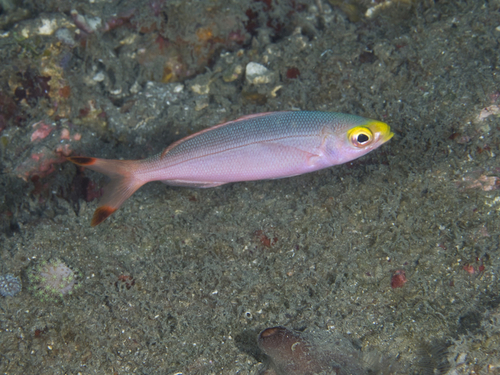
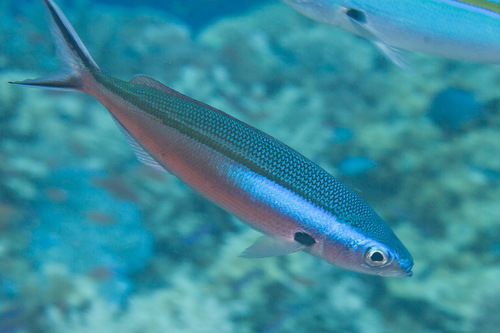
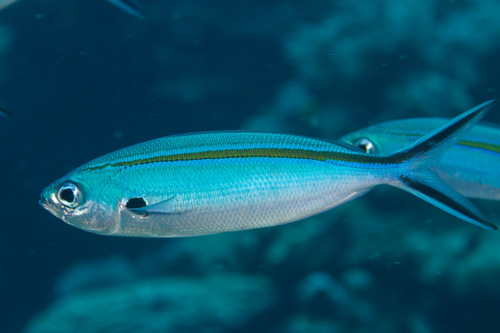
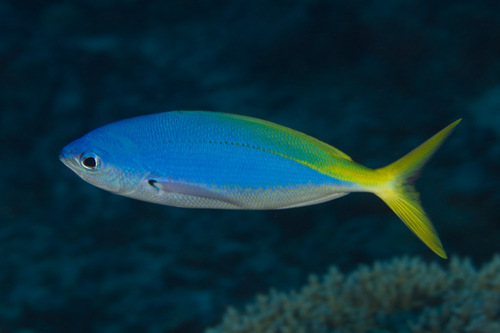
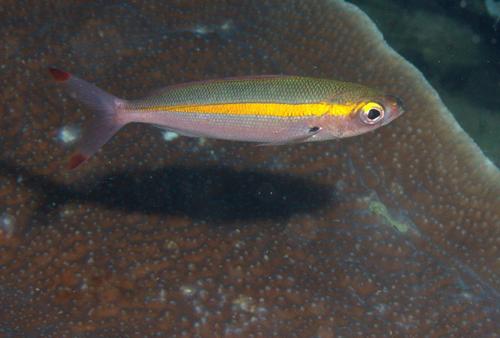
The goldband fusilier, Pterocaesio chrysozona, has a fusiform, elongated body that is moderately compressed along its lateral sides. It has small conical teeth located in its jaws, on the vomer, and on the palatines. Its dorsal fin has 10–11 spines and 14–16 soft rays, while the anal fin has 3 spines and 11–13 soft rays. Both the dorsal and anal fins bear scales, and the pectoral fins have 17–20 rays. This species reaches a maximum total length of 21 centimetres (8.3 inches). Its overall body colour ranges from pale blue to brownish, fading to pinkish or white on the underside. A wide yellow stripe runs along its flanks, positioned immediately below the lateral line. This species occurs in the tropical Indian and Western Pacific Oceans. Its range extends along the eastern coast of Africa from Mozambique north to the Red Sea, and continues east across the Indian Ocean, though it is not found in the northern Arabian Sea or the Persian Gulf. In the Pacific Ocean, its range reaches east as far as the Solomon Islands, north to the Yaeyama Islands, and south to Australia. In Australia, goldband fusiliers are found along the coast from the Dampier Archipelago in Western Australia to Sydney. They inhabit depths between 5 and 35 metres (16 and 115 feet), and can be found among coral reefs and seagrass, along outer reef slopes, and around pinnacles in deep lagoons.