About Pternistis erckelii (Rüppell, 1835)
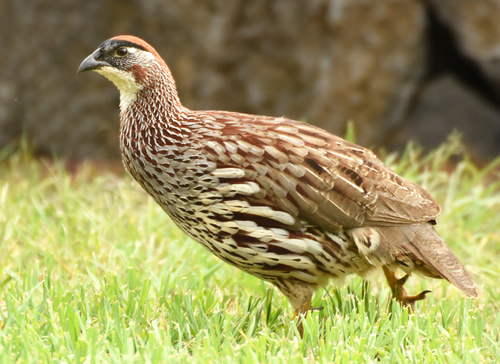
Erckel's spurfowl, scientifically named Pternistis erckelii (Rüppell, 1835), is the largest spurfowl native to Africa. This species measures 38–43 cm (15–17 in) in total length, with females being slightly smaller than males. Based on a sample of three male specimens, males weigh between 1.05–1.59 kg (2.3–3.5 lb); one recorded female specimen weighed 1.136 kg (2.50 lb). Males and females have similar plumage patterns. Both the upper and lower parts of the body are covered in chestnut-colored stripes. The species has a black face and black bill, a chestnut-colored crown and nape, yellow legs, white ear coverts, and a single white streak running behind the eye. Erckel's spurfowl is native to northern Eritrea, northern Ethiopia, and northeastern Sudan. The species was introduced to Hawaii in 1957 to be used as a gamebird, and it has also been introduced to Italy. It inhabits areas located 2,000 to 3,500 metres (6,600 to 11,500 ft) above sea level, including the mountainous Degua Tembien district. While its exact total population size has not been determined, it is a common species with an estimated range of 580,000 km2 (220,000 sq mi). For this reason, the International Union for Conservation of Nature lists Erckel's spurfowl as a species of least concern. Erckel's spurfowl forages either alone or in pairs in scrublands or at forest edges. Its diet includes plant materials such as berries, seeds, and shoots, alongside insects. It is often inactive, but will run uphill when threatened. It gives loud territorial calls from clifftops and large rocks; these calls are made up of 15–20 notes. The vocalizations are repeated frequently over long periods, and have been described as "an insane cackled laughter, speeding towards the end with a bouncing ball pattern". Females lay eggs during the rainy season, which falls between April and November, with the exact laying window varying by location. In Ethiopia, eggs are laid in May and from September to November, while in Sudan they are laid in April and May.