About Pteraster tesselatus Ives, 1888
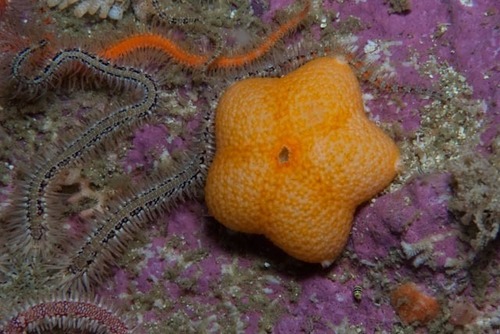
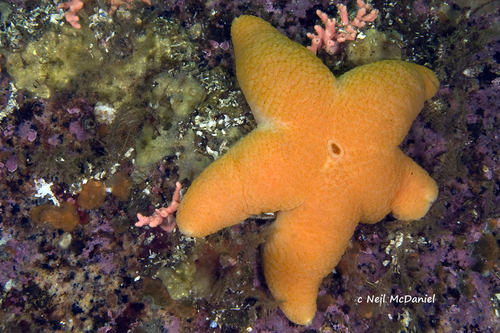
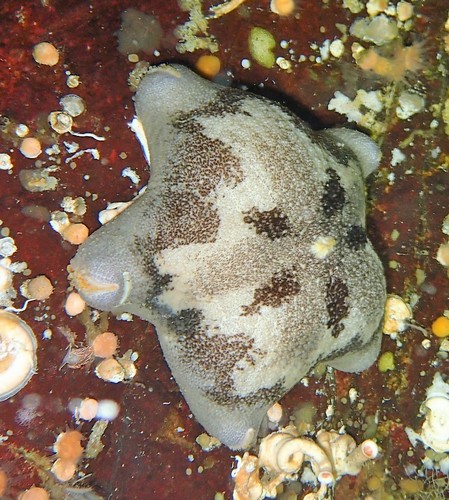
This species, commonly known as the slime star, has a wide central disc and five short, thick arms with upturned tips. It reaches a diameter of approximately 15 cm (5.9 in), and has an inflated appearance. Its entire aboral (upper) surface is covered by a thick, raised, fleshy membrane that has a smooth, soft texture. This membrane can be pale brown, grey, red, or orange, and often features a symmetrical darker pattern. The membrane hides the madreporite and the scales of the actual aboral surface, and the gap underneath the membrane is filled with spongy tissue. A central pore in this membrane allows water to move through it. Along the arms, rows of fan-shaped groups of five to seven spines sit between two rows of tube feet. A red eyespot, surrounded by spines, is located at the tip of each arm. The slime star is found in rocky habitats on the west coast of North America, ranging from the Bering Sea south to central California, at depths down to 950 m (3,120 ft). It is also documented from the Aleutian Islands and Japan, and typically occurs in areas with strong currents.