About Pterapogon kauderni Koumans, 1933
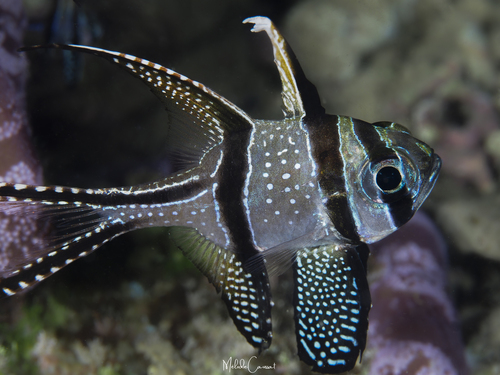
This species grows up to 8 centimetres (3 inches) in total length. It can be easily distinguished from all other cardinalfishes by several key features: its tasseled first dorsal fin, elongated anal and second dorsal fin rays, deeply forked caudal fin, and a specific color pattern. The color pattern includes three black bars across the head and body, plus prominent black anterior edges on the anal and second dorsal fin. Males can be told apart from females by a noticeable, enlarged oral cavity, which is only visible when males are brooding. This species is restricted to the Banggai Islands of Indonesia. It has an extremely limited geographic range of 5,500 square kilometers, and an estimated total population size of 2.4 million. Isolated populations of Banggai cardinalfish are concentrated around the shallow waters of 17 large and 10 small islands within the Banggai Archipelago. A small population also lives off Central Sulawesi, inside Luwuk harbor. One extra population became established in the Lembeh Strait, North Sulawesi, 400 kilometers north of the species' natural distribution range, after being introduced by aquarium fish traders in 2000. Small populations were recorded in May 2014 in Secret Bay, north west Bali. The Banggai cardinalfish is the only diurnal member of its family. It is a demersal tropical marine fish that forms stable groups of around 9 individuals in shallow water, and is most common at depths between 1.5 and 2.5 meters. It lives in a variety of shallow habitats, including coral reefs, seagrass beds, and open areas of sand and rubble. It is most abundant in calm habitats on the protected side of larger islands. The Banggai cardinalfish is a paternal mouthbrooder. Females take an active role in courtship and pair formation, which happens a few hours to a few days before spawning. Mating pairs set up spawning territories several meters away from the main group and defend these territories vigorously. The eggs are around 2.5 millimeters in diameter. After hatching, young remain in the male's mouth cavity for an undetermined amount of time. Unlike many other marine fish species, the Banggai cardinalfish does not have a planktonic stage in its life history. This species has a short lifespan, reaching around 4 years in optimal captive conditions, and likely living 1 to 2 years in the wild. Banggai cardinalfish are sexually monomorphic. Pairs can form up to 2 weeks before spawning. The female courts the male from the point of pair formation through spawning. A female's size determines her fecundity and the size of her eggs, while a male's size determines the pair's reproductive output, meaning the total number of eggs the pair can produce. Because of this, pairing usually happens between individuals of similar sizes, so the male can successfully care for all the eggs the female produces.