About Pteraeolidia ianthina (Angas, 1864)
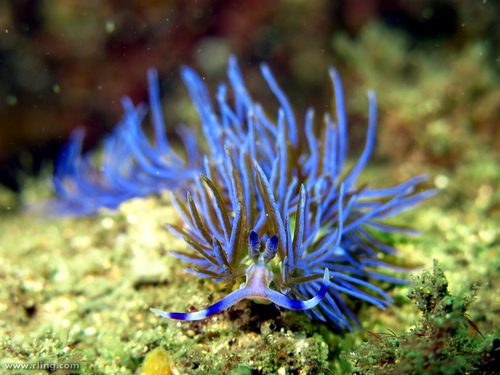
Pteraeolidia ianthina (Angas, 1864) is one of the most commonly encountered aeolid nudibranchs. Eastern Australian divers often call it the "blue dragon" because it closely resembles a Chinese dragon, and it is one of the most common aeolid nudibranchs found in Eastern Australia. This species can deliver a painful sting to humans.
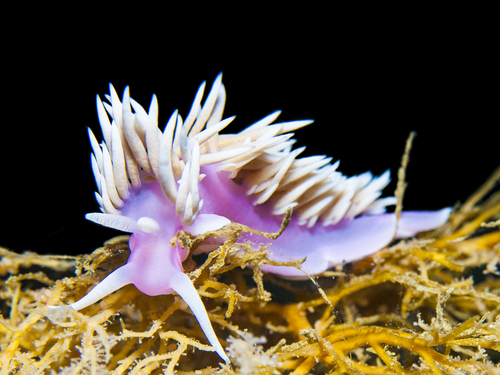
The body of Pteraeolidia ianthina is translucent tan, but its cerata—structures which range in color from dark purple to lavender to golden brown—are responsible for most of the species' distinct appearance. Green-colored specimens of this nudibranch are not uncommon. The slug has an elongated body that reaches a maximum length of 20 cm (7.9 in), with multiple clusters of medium-large cerata running along the full length of its body. Its thick rhinophores and long cephalic tentacles have at least two prominent dark purple bands. The tips of the cerata hold nematocysts.
Algal zooxanthellae of the genus Symbiodinium, obtained from the nudibranch's food, continue to carry out photosynthesis inside the slug's body, and produce brown and green pigments. Both Symbiodinium and the nematocysts are thought to come from the species' coelenterate prey. Symbiodinium live inside vacuoles in host cells that originate from the endoderm.
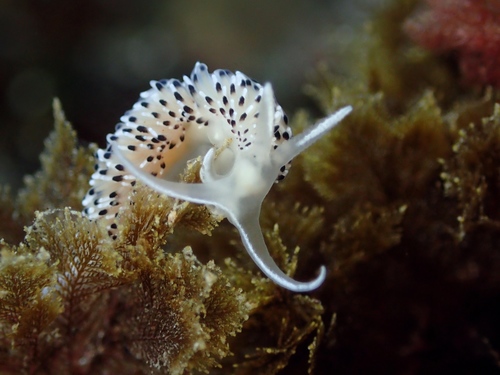
Young Pteraeolidia ianthina specimens are much smaller, completely white, with purple pigment only on the tips of their rhinophores and cephalic tentacles. They also have fewer cerata, and are frequently misidentified as other nudibranch species.
This species was once considered to be widespread across the entire Indo-Pacific, but recent research indicates it only inhabits the coastal waters of eastern Australia. The only other currently recognized species in the genus Pteraeolidia, Pteraeolidia semperi, is actually a species complex made up of more than one distinct species.