About Psychoda alternata Say, 1824
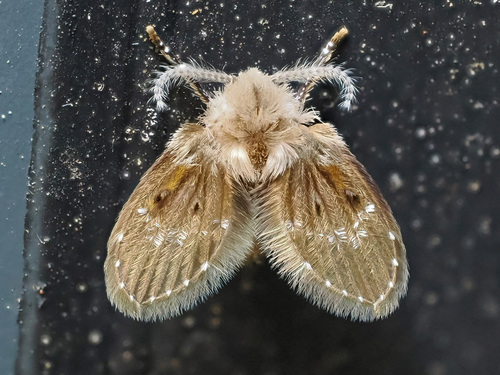
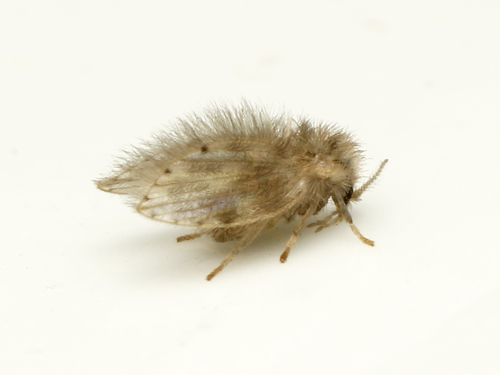
Adult female Psychoda alternata are approximately 4 mm (0.2 in) long, while males are slightly smaller. Their wings are broad, held at an angle away from the body, covered in dense tufts of hairlike scales along the veins, and are grey with a mottled appearance. Their wing muscles are relatively weak, so these insects mostly run or hop, and only occasionally make short flights. Males hatch first and only survive for a few days, while unmated females may live up to a week. This species originated in North America and has since spread around the world, with a confirmed range that includes Europe, western Asia, and South America. It became established in Britain by 2000, Brazil by 2006, Norway by 2011, Iraq and Croatia by 2013, and Spain by 2016. Larvae develop in moist areas rich in organic matter, including drains, trickling filter systems, ditches, and sludges of decaying organic matter. Adult insects seldom move far from their hatching site. Females lay eggs in the moist locations where larvae will feed, laying up to 100 eggs total. Eggs are sometimes laid singly, but usually in gelatinous batches of 15 to 40. The eggs are translucent and less than one millimetre in diameter. At 70 °F (21 °C), eggs hatch in about two days. Larvae are slender, and range in colour from whitish and cream to pale brown. They have a head with strong jaws, 11 body segments, and siphons on their rearmost two segments. At 70 °F, the larval stage lasts approximately 15 days. This species typically overwinters in the larval stage in diapause. Pupae range from yellowish brown to brown, and have a pair of ear-like respiratory processes on the head end. The pupal stage lasts one or two days. Both larvae and pupae are usually found in the top 2.5 cm (1 in) of their growing substrate, and may go deeper when the material is fairly dry. A trickling filter system is a form of biological treatment widely used for sewage processing, where sewage or other wastewater flows downward over a medium such as gravel supported by a permeable membrane. Over 200 species of bacteria, algae, worms, protozoa, and insects (including drain fly larvae) live in this medium, and together these organisms form a biofilm that processes fluid passing through the filter system and removes pollutants.