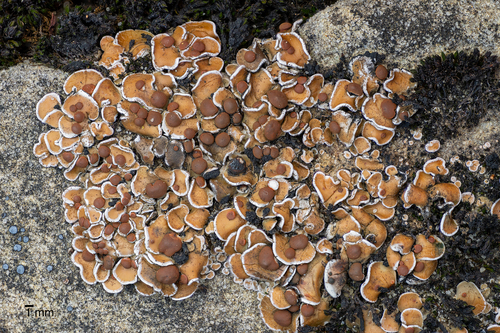
About Psora pseudorussellii Timdal
The thallus of Psora pseudorussellii Timdal is squamulose, and forms patches that range from scattered to contiguous. Individual squamules reach up to around 4 mm across, are typically more or less elongated, and grow either adnate to the substrate or slightly ascending; they may become partially overlapping (imbricate). The upper surface of the squamules is medium brown, ranging from dull to slightly shiny, and often has visible fissures. It may be epruinose, or partially covered in a layer of white pruina. The margin of each squamule is white, and ranges from straight to slightly upturned. It stays entire when young, but often becomes somewhat lobed as the lichen ages. The lower surface of the squamule is white to pale brown. The common name "bordered scale" comes from this characteristic white margin. Internally, the upper cortex is relatively thick, measuring approximately 90–140 μm, and contains abundant calcium oxalate. The medulla is filled with calcium oxalate, and the lower cortex is usually well developed. Apothecia form on the surface of the thallus, reach up to around 1.5 mm across, and are flat when young. As they age, they may become strongly convex to hemispherical, and sometimes lose their distinct visible margin. Ascospores are simple, measuring approximately 8–12 × 5–7 μm. Pycnidia have not been observed in this species. No lichen substances have been detected in the thallus. Psora russellii is similar in overall appearance, but can be distinguished by its rounder, center-depressed squamules, apothecia that grow close to the edges of squamules, and the presence of norstictic acid. Psora pseudorussellii grows on calcareous rock, apparently primarily limestone. It is strictly saxicolous, growing on exposed rock surfaces and outcrops rather than on soil. In North America, it has been reported from southeastern Canada (including Ontario and Quebec), across the eastern and southern United States, and extending into northern Mexico, where it has been recorded from Coahuila. Confirmed reported elevations for the species range from approximately 150 to 1,830 m (490 to 6,000 ft). A European collection previously identified as this species is now considered to be the Mediterranean species Psora mediterranea. A 2025 study summarized the confirmed range of P. pseudorussellii as eastern and southern North America, stretching from Ontario and Quebec south into Mexico as far as Oaxaca. The study also noted that reports of this species from the southwestern United States, for example California, require further confirmation.

