About Psophodes cristatus (Gould, 1838)
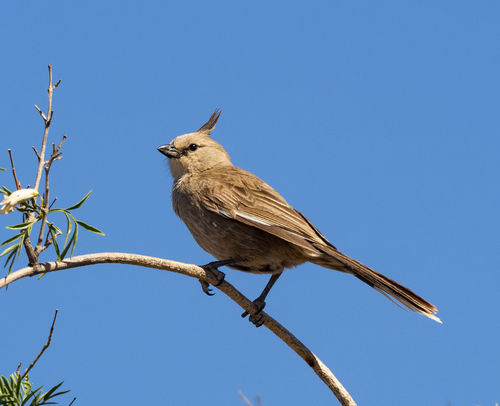
The chirruping wedgebill, scientifically named Psophodes cristatus (Gould, 1838), is a medium-sized bird. It measures approximately 18–21 cm in length and weighs between 31 and 64 g. Mature individuals have a dark, wedge-shaped bill, while immature individuals have a horn-coloured bill. The species has a slim upright crest and a long rounded tail. Adult plumage has pale brown upperparts and white or pale grey underparts. Flight feathers are edged with white, and the tail is dark black-brown with a white tip. Immature birds have similar plumage to adults; the main difference is that immature flight feathers have buff tips, rather than the white tips seen on mature birds. This species is often misidentified as the chiming wedgebill (Psophodes occidentalis). Key identifying features that distinguish it are faint breast streaking, a slightly longer tail, and a repetitive chirruping call. The chirruping wedgebill occurs across south-eastern inland Australia, where it inhabits low, open shrublands that contain acacia species. Its distribution is patchy, but the species is usually locally abundant in areas where it is found. Even though it occupies a large overall range, it is rarely encountered in the southern portion of its range. It favours areas with vegetation including bluebush, acacia stands, emu bush and lignum species. The chirruping wedgebill is territorial year-round. Adults are generally sedentary, and small flocks of up to 20 birds are regularly recorded. Juvenile birds are more widely dispersed, and sometimes form loose foraging flocks of up to 100 individuals that wander over greater distances than adults do. This species is unobtrusive and reserved, and it is less shy than the chiming wedgebill, except when it is calling. When foraging, individuals move between cover by making short flights consisting of small flutters and glides, or by running. The chirruping wedgebill is non-migratory.