About Psolus chitonoides Clark, 1901
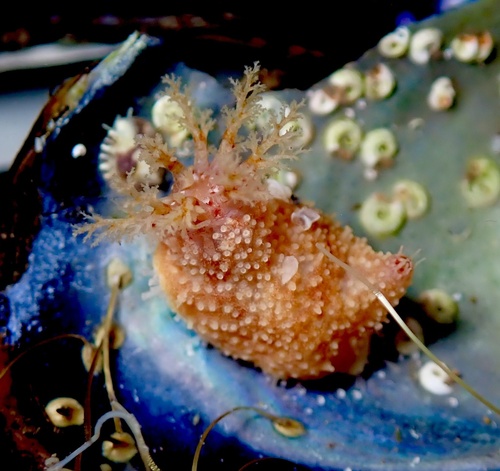
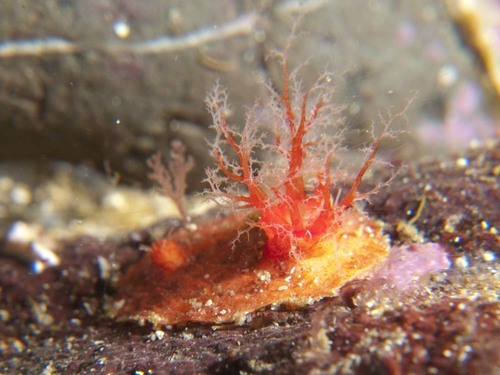
Psolus chitonoides, commonly called the slipper sea cucumber, has an oval body that is roughly 7 cm (3 in) long and 5.8 cm (2.3 in) wide. Its upper surface is domed, while its lower surface, called the sole, has an extensive arrangement of tube feet. A staggered row of large tube feet runs along the center of the sole. One or two rows of stout tube feet run on either side of this central row, close to the edge of the sole, and a single row of smaller tube feet set in pits runs along the edges of the sole. The mouth is located at one end of the animal and is surrounded by a ring of tentacles. These tentacles are repeatedly branched, number between eight and ten, and may all be the same size, or include two tentacles smaller than the rest. The anus sits on the dorsal surface at the opposite end from the mouth. The sea cucumber's skin is leathery, slightly spiny, and protected by rows of stiff, overlapping scales. The scales are yellow to bright orange, and the tentacles are red with white tips. This species is found along the western coast of North America, with its range stretching from the Aleutian Islands to Baja California. It inhabits both exposed coasts and quiet inlets, living in the sublittoral zone down to depths of approximately 247 m (800 ft). Its soft, flexible sole allows it to adhere to rocks, and it is commonly found clinging tightly to vertical rock faces. The slipper sea cucumber is a suspension feeder, intercepting floating particles that pass by it. These particles are trapped by sticky papillae on its feeding tentacles. This species has a high concentration of saponins in its tissues, which makes it toxic. As a result, it is avoided by most predatory fish, gastropod molluscs, and crabs, and tests have confirmed its flesh is unpalatable to the tidepool sculpin (Oligocottus maculosus). Its primary predators are starfish, particularly the leather star (Dermasterias imbricata). Juvenile slipper sea cucumbers are negatively phototactic, and the species produces bright red eggs.