About Psittacus erithacus Linnaeus, 1758
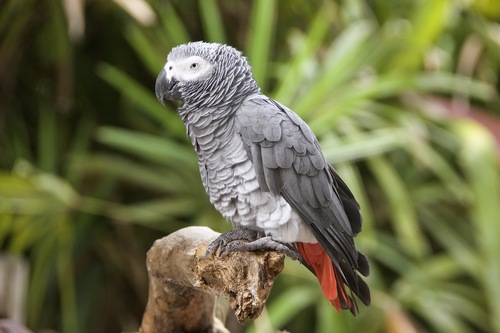
Psittacus erithacus Linnaeus, 1758, commonly known as the grey parrot, is a medium to large sized parrot with predominantly grey plumage and a black bill. Adult grey parrots weigh between 418 and 526 g (14+3⁄4–18+1⁄2 oz), with a typical weight around 400 g (14 oz), an approximate length of 33 cm (13 in), and a wingspan ranging from 46 to 52 cm (18–20+1⁄2 in). The head and wings are generally darker than the body. Head and body feathers have slight white edges, while tail feathers are red. Both sexes look similar in appearance. Juvenile grey parrots have colouration similar to adults, but juveniles typically have dark grey to black eyes, compared to the yellow irises surrounding dark pupils in adults, and their undertail coverts are tinged with grey. Grey parrots may live 40 to 60 years in captivity, while their average lifespan in the wild is shorter, at approximately 23 years. They begin breeding at 3 to 5 years of age and lay 3 to 5 eggs per brood. The grey parrot is native to equatorial Africa, including Angola, Cameroon, the Congo, Gabon, Ivory Coast, Ghana, Kenya, and Uganda, with a native range extending from Kenya to the eastern part of Ivory Coast. Current global population estimates are uncertain, ranging from 630,000 to 13 million birds, and populations are decreasing worldwide. The species prefers dense forests, but can also be found at forest edges and in more open vegetation types such as gallery forests and savanna forests. A 2015 population study found that the species has been virtually eliminated from Ghana, with numbers declining 90 to 99% since 1992. The species was found in only 10 out of 42 surveyed forested areas, and three roosts that once held 700 to 1200 birds each held only 18 birds in total. Local people mainly blamed the pet trade and timber felling for this decline. Populations are thought to be stable in Cameroon. In the Congo, an estimated 15,000 grey parrots are taken each year for the pet trade from the eastern part of the country, while the stated annual quota is 5,000. The Florida Fish and Wildlife Conservation Commission has recorded escaped or released grey parrots in South Florida since at least 1984, but there is no evidence that this population breeds naturally. Little is known about the behaviour and activities of grey parrots in the wild. Beyond a lack of research funding, studying wild grey parrots is especially difficult because they are prey animals, which gives them a secretive nature. It has been confirmed that wild grey parrots can imitate a wide variety of sounds they hear, just like captive grey parrots. In the Democratic Republic of the Congo, two wild grey parrots recorded while roosting reportedly had a repertoire of over 200 different calls, including nine imitations of other wild bird songs and one imitation of a bat.