About Psittacula krameri (Scopoli, 1769)
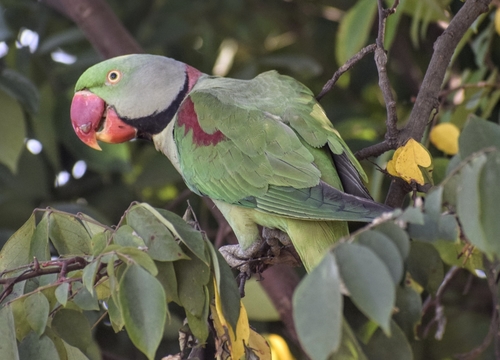
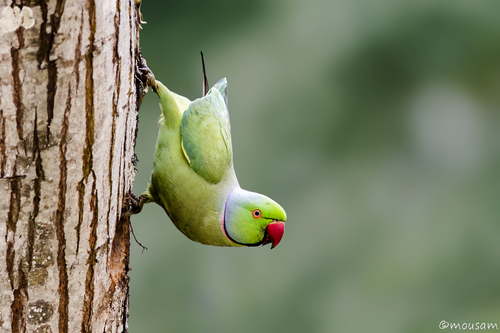
Psittacula krameri, more commonly known as the rose-ringed parakeet, measures 37–43 cm (15–17 in) in total length when including tail feathers, which make up a large portion of this overall length. Folded wing length, measured from the outer wing joint to the wing tip, ranges from 14 to 16 cm (5.5 to 6.3 in) for African birds, and from 15 to 19 cm (5.9 to 7.5 in) for Asian birds. Tail length ranges from 17 to 27 cm (6.7 to 10.6 in) for African birds, and from 16 to 29 cm (6.3 to 11.4 in) for Asian birds. Among Asian subspecies, P. k. borealis has longer tails than P. k. manillensis, and across all populations, males have longer tails than females. Body weight ranges from 51–93 g for African birds, and from 104–143 g (rarely reaching 174 g) for Asian birds. The rose-ringed parakeet is sexually dimorphic. Adult males have a distinct pink and black neck ring, while females and immature birds of both sexes either have no neck rings, or only faint shadow-like pale to dark grey neck rings. Both sexes have a characteristic bright green plumage in wild populations, paired with a red beak and blue tail. This is a noisy species with a distinctive, easily recognizable squawking call. Rose-ringed parakeets are herbivorous and non-migratory. In its native range, the species occurs across Africa in a narrow belt spanning the full width of the continent between approximately 4° to 17° N latitude, an area roughly matching the Sudanian savannas. In Asia, its native range covers the Indian subcontinent and Sri Lanka between 6° to 35° N latitude, extending into the Himalayan foothills, from the Indus River valley in Pakistan east to the Irrawaddy River valley in Myanmar. Since the late 20th century, rose-ringed parakeets have successfully colonized many additional countries, following escapes from captivity and deliberate releases. Today, this species breeds further north than any other parrot species, and has established large widespread populations in Germany, France, Belgium, the Netherlands, Italy, and the United Kingdom (see the Feral Birds section below). These colonization patterns suggest the risk of further parakeet establishment may increase as global warming reduces the number of frost days, alongside rising urbanization and growing human populations. Because Europe has received large, distinct separate imports of parakeets, researchers are able to study the common hypothesis of climate matching and human activity at the species level. For Indian rose-ringed parakeets in northwestern India, pairs form between September and December. These parakeets do not form lifelong pair bonds, and often mate with a new partner in the following breeding season. During the cool winter season, they select and defend nesting sites, which lets them avoid competition for nesting sites with other bird species. Feeding on winter pea crops provides female parakeets with the nutrients needed for egg production. Adults care for their young from April to June, and fledglings leave the nest before the arrival of the monsoon. Seasonal changes in testicular activity, along with levels of plasma luteinising hormone (LH), estradiol (E2), testosterone (T), and 5 α-dihydrotestosterone (5 α-DHT), have been linked to pair bond formation, nest building, nest defense, and parental behavior in free-living Indian rose-ringed parakeets in northwest India. Breeding during the winter offers multiple advantages: it lets parakeets avoid competing with other bird species for nesting sites, ensures young are not reared during the monsoon season, and allows females to take advantage of the winter pea harvest for extra nutrients needed for egg development. Supplements marketed for Indian ring-necked parakeets, which contain calcium carbonate, vitamin D3, and other minerals and vitamins to support calcium absorption, are commonly used by parakeet owners and breeders to prevent egg-laying complications and brittle bones.