About Psittacula columboides (Vigors, 1830)
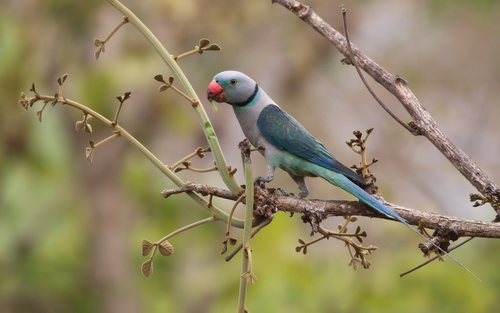
The blue-winged parakeet (Psittacula columboides) has bluish grey plumage and a long, yellow-tipped tail. Both mature males and females have a complete black neck ring. Males have a bluish-green lower edge to the black collar, and an upper mandible that is red with a white tip. Females have an all-black bill and only the solid black collar. Female blue-winged parakeets look similar to female plum-headed parakeets, but can be distinguished by the broad yellow collar present on plum-headed parakeet females. Flocks travel through forest habitat while vocalizing with a series of screeching keek-keek-keek calls. Blue-winged parakeets breed during the dry season that follows the northeast Monsoon, and chicks fledge before the southwest Monsoon in June. They nest in tree holes, often in tall trees of the species Mesua ferrea, and especially reuse old woodpecker and barbet nests. Breeding activity begins in December, and eggs are laid in December and January. A typical clutch contains 4 eggs, which hatch after approximately 23 days of incubation. Initially, the female broods the eggs while the male brings food; later the male takes over brooding duties. Chicks fledge around one month after hatching and leave the nest. Blue-winged parakeet chicks are sometimes trapped to be sold for the pet trade. Individual birds have been observed feeding on the leaves of Loranthus longiflorus. The closest living relative of the blue-winged parakeet is Layard's parakeet, a species endemic to Sri Lanka. This parakeet is found only in the Western Ghats of India, ranging from south of approximately 19°N (near Kasa, north of Bombay) to Kerala. Its range extends into the hills of the Palnis and Nilgiris, as well as the adjacent Eastern Ghats including the Biligirirangan range, and possibly further east into India's Kolli Hills.