About Psittacanthus robustus (Mart.) Mart.
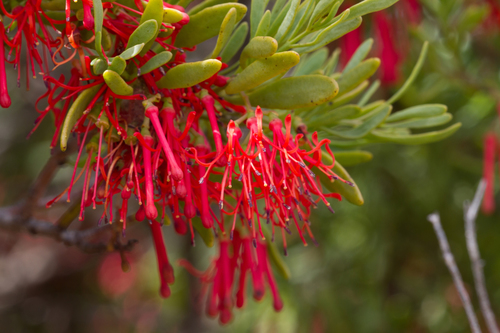
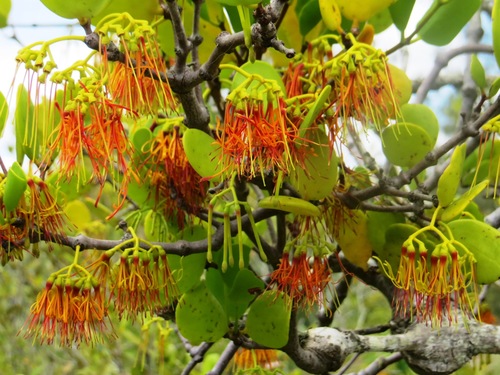
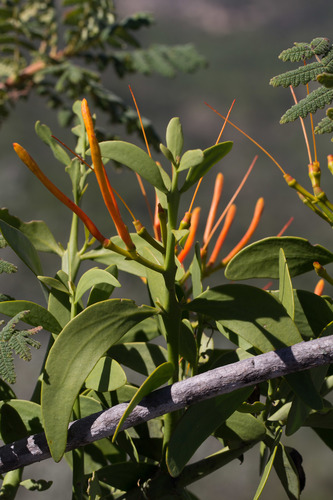
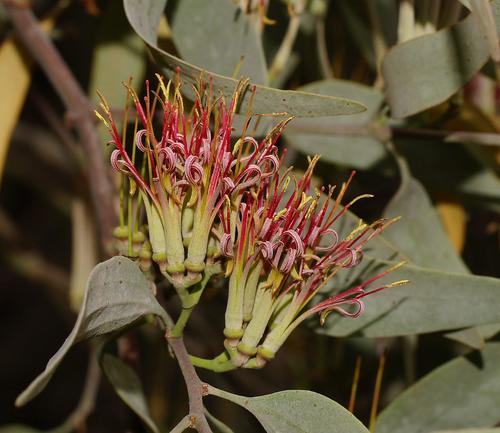
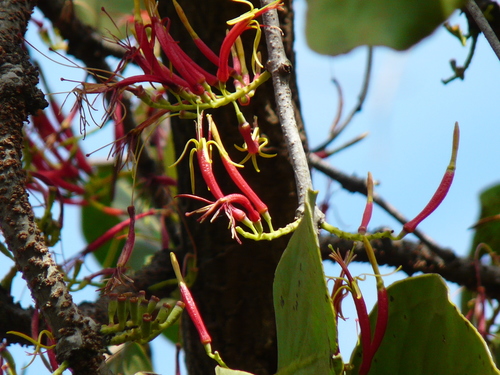
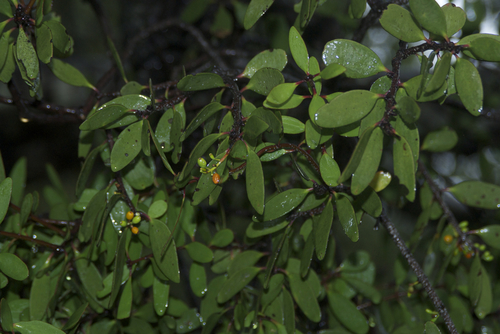
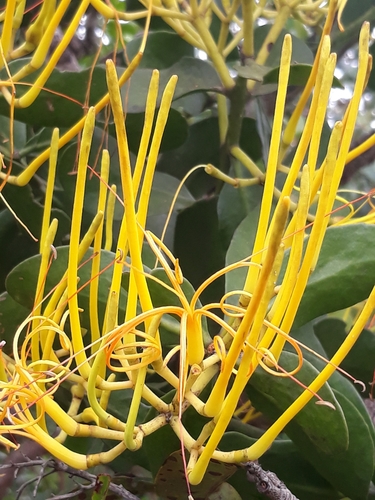
Morphological description: Young branches of Psittacanthus robustus are erect, while mature adult branches are pendulous. Cross-sections of branches have a square shape. Leaves have petioles, and both the leaf base and apex are obtuse. Inflorescences grow both at the end of branches and in leaf axils, and are structured as umbels made up of triads—groups of three flowers—that range in color from yellow to orange. Immature fruits are light green, and ripen to a black color, with an appearance similar to an olive. The seeds have three cotyledons and contain a sticky internal substance.
Distribution: Psittacanthus robustus has been recorded in Northern Amazon, northern Brazil, northeastern Brazil, southeastern Brazil, west-central Brazil, Colombia, Guyana, and Venezuela. It occurs in Amazonian rainforests, Caatinga, the Central Brazilian Savanna, and the Atlantic Rainforest.
Ecology: Three bird species have been documented eating and excreting the seeds of this species. The most frequent of these is the swallow tanager Tersina viridis viridis; the other two species are the cinnamon-tanager Schystoclamys ruficapillus ruficapillus, and the sayaca-tanager Thraupis sayaca sayaca. Psittacanthus robustus, a mistletoe, has been found growing on 13 host species from the plant families Vochysiaceae and Melastomaceae.