About Psittacanthus calyculatus (DC.) G.Don
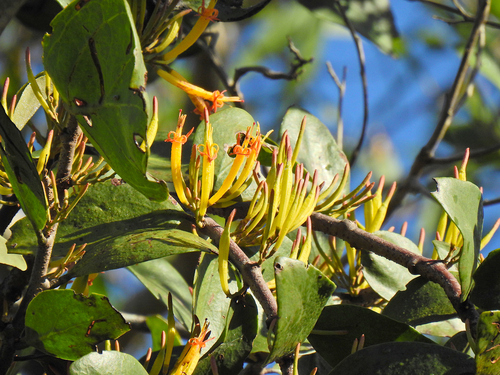
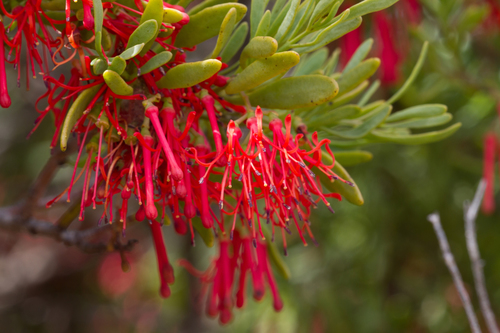
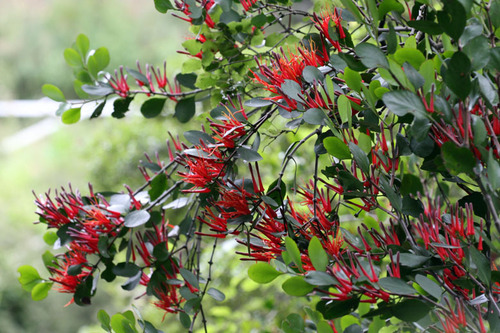
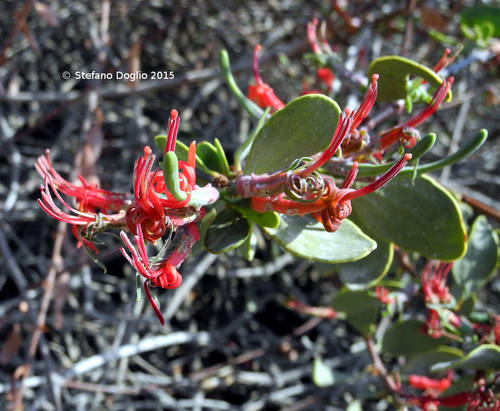
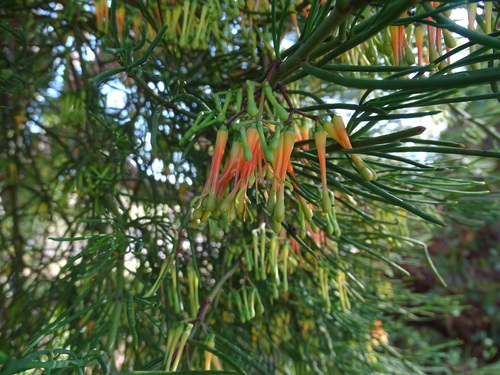
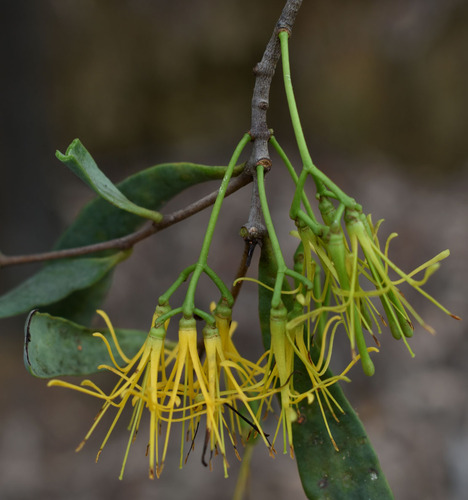
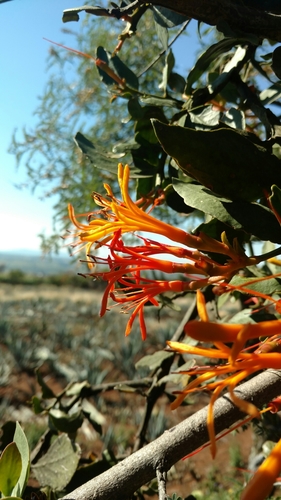
Psittacanthus calyculatus is a completely hairless mistletoe with nearly cylindrical branches. Its leaves grow in opposite pairs, are oval or lance-shaped, have almost no petiole, and lack visible veins. Its inflorescences grow at the end of branches, and each holds a group of three yellow to scarlet flowers, with cup-shaped bracts located under each flower. Fruits of this species mature between October and November. After a bird eats the mature fruit, it excretes the plant's seed. If the seed is deposited on a suitable host branch by November, it can infect the host and begin producing initial buds. Vegetative growth continues after infection, and the plant first flowers in November, four years after the initial infection. Fruit matures the following year between October and February, meaning the full life cycle of Psittacanthus calyculatus takes approximately five years to complete. According to a 2002 report by Vasquez Collazo and Geils, eleven species of conifers have been observed as hosts for Psittacanthus calyculatus: Abies religiosa, Pinus gordoniana, P. lawsonii, P. leiophylla, P. michoacana, P. pseudostrobus, P. teocote, P. montezumae, P. herrerai, P. pringlei, and P. rudis. At least nineteen bird species spanning insectivores, omnivores, and granivores have been observed feeding on the fruits of this species.