About Psilopsiagon aymara (Orbigny, 1839)
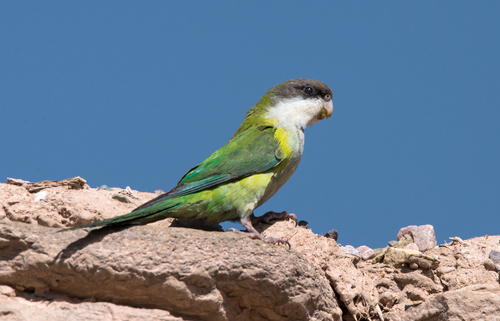
The grey-hooded parakeet (Psilopsiagon aymara) is a small, slender parakeet that reaches an adult length of approximately 20 centimeters (8 inches). Its upper body parts are green, while its flanks and underwing coverts are greenish-yellow. The forehead and crown are brownish-grey, and the chin, throat, and breast are whitish-grey; the sides of the breast sometimes develop a bluish tinge. The belly is green with a bluish tinge. The upper side of its long, narrow, pointed tail is green, and the underside is grey. The beak is flesh-colored, the iris is brown, and the legs and feet are brownish-grey. Males and females have a similar overall appearance, but males often have a more vivid grey breast, and immature individuals have shorter tails. This parakeet is native to the southern Andean Yungas, with a range extending from southern Bolivia to northern Argentina, and possibly reaching the northern fringes of Chile. It inhabits arid shrubby or wooded areas, wooded ravines, and dense shrubby regions near villages or agricultural land. It occurs at altitudes between roughly 1,800 and 4,000 meters (6,000 to 13,000 feet). It is a gregarious bird that forms small flocks of around 20 individuals; multiple such flocks may gather together at watering spots. Flocks travel across the landscape in fast, low, undulating flight. They sometimes rest on or among the branches of shrubs and small trees, producing twittering and warbling calls very similar to the sounds made by barn swallows. They forage for food in low vegetation, eating grass seeds, seeds from plants in the aster family, berries, and fruits. They also forage on the ground to collect fallen seeds and fruits. Breeding occurs in November. Nests are placed in holes excavated in earthen banks, in rock crevices, in holes in cacti, and sometimes in ruined buildings. Multiple nests are sometimes grouped close together in a semi-colonial arrangement. Clutches usually contain four or five eggs.