About Psilopogon viridis (Boddaert, 1783)
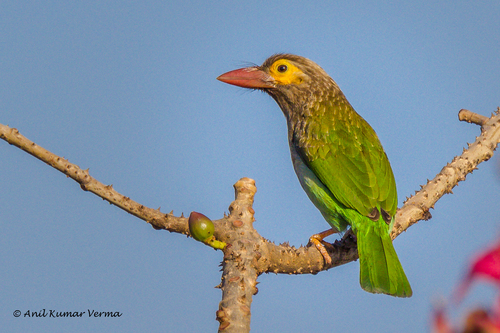
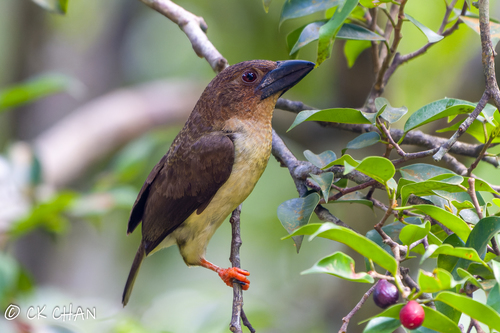
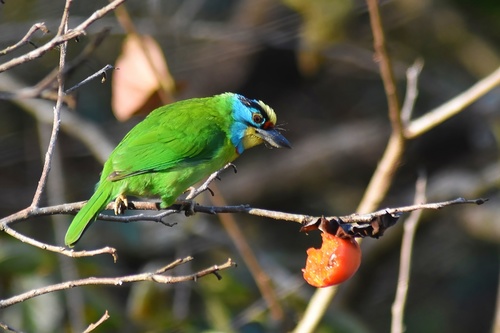
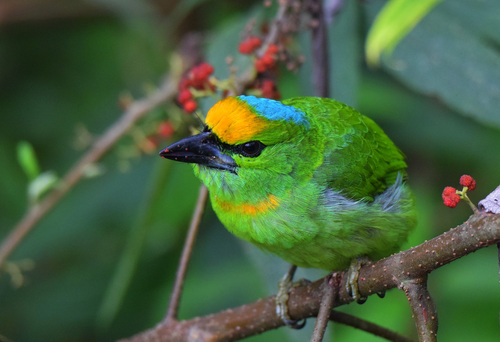
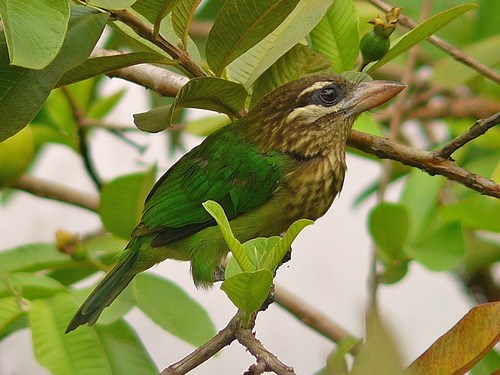
The white-cheeked barbet, scientifically named Psilopogon viridis (Boddaert, 1783), measures 16.5–18.5 cm (6.5–7.3 in) in length. It has a brownish head streaked with white that sometimes gives it a capped appearance, and a pale pink bill. Individuals from northern populations are larger than those from southern populations. Like many other Asian barbets, white-cheeked barbets have green plumage, sit still, and perch upright, which makes them difficult to spot. Their breeding season begins at the start of summer, during which their calls become loud and constant, especially in the mornings. Their call is a monotonous Kot-roo...Kotroo... that starts with an explosive trrr, and is not easily distinguished from the call of the brown-headed barbet. During hot afternoons, they may also produce a single-note wut call that is not unlike the call of a collared scops owl or coppersmith barbet. They produce other harsh calls during aggressive encounters. The main range of the white-cheeked barbet extends along the Western Ghats south from the Surat Dangs, along the associated hills of southern India, and into parts of the southern Eastern Ghats, mainly in the Shevaroy and Chitteri Hills. In some areas, it has been suggested that this species may have displaced the brown-headed barbet, which was formerly the dominant barbet species in these areas. Indian ornithologist Salim Ali observed that some individuals call at night during the breeding season, but other observers have questioned this note, stating that the species appears to be strictly diurnal. White-cheeked barbets forage for food in trees and rarely visit the ground. They get most of the water they need from the fruit they eat. When water is available in a tree hole, they will sometimes drink and bathe. They are mostly frugivorous, feeding on the fruits of various Ficus species including Ficus benjamina and Ficus mysorensis, but will take winged termites and other insects opportunistically. They also feed on the fruits of introduced tree species such as Muntingia calabura. When foraging, they are aggressive, and will attempt to chase away other barbets, Asian koels, and other frugivores. White-cheeked barbets play an important role in forests as seed dispersal agents. They also visit the flowers of Bombax to feed on nectar, and may be involved in pollination. Because they eat fruit, they are a minor nuisance in fruit orchards, although they are noted to have a beneficial effect in coffee plantations. A species of tick in the genus Haemaphysalis is known to have a specific parasitic association with the white-cheeked barbet, and some species of Leucocytozoon are known to be blood parasites of the species. Some species of Haemaphysalis are known to carry the virus that causes Kyasanur forest disease. Shikras have been recorded preying on adult white-cheeked barbets.