About Psilopogon malabaricus (Blyth, 1847)
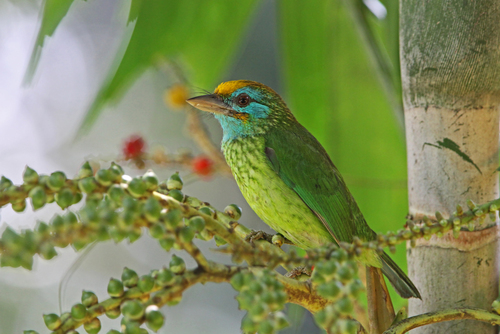
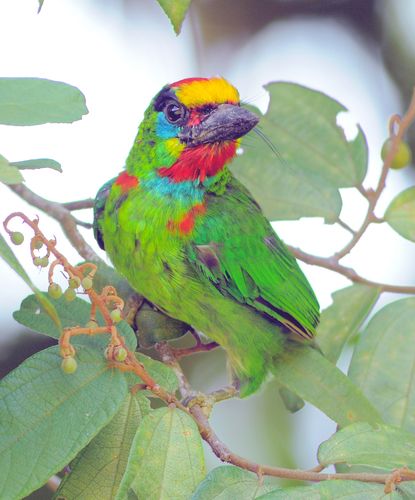
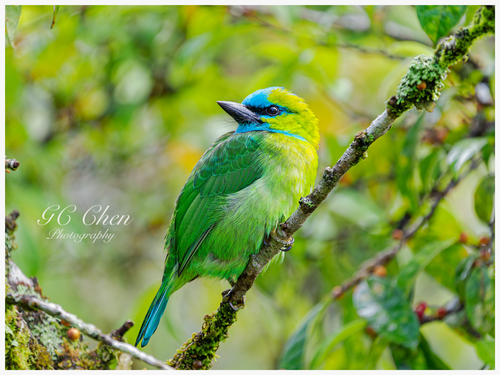
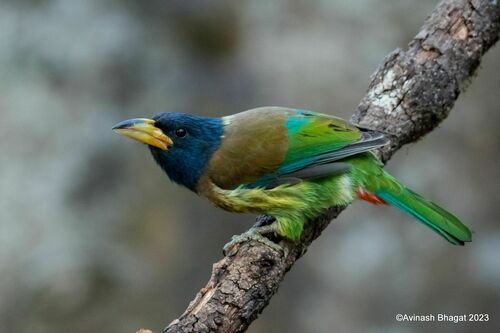
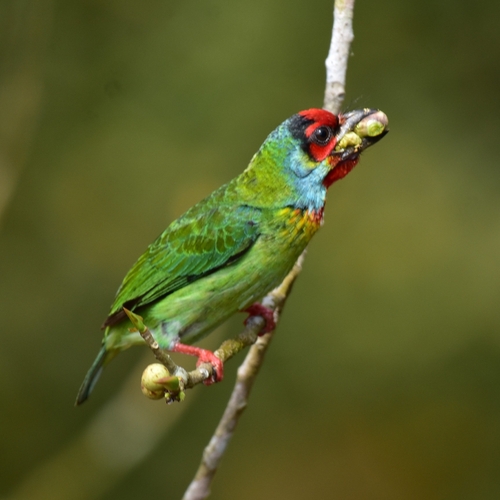
Psilopogon malabaricus can be distinguished from the coppersmith barbet by its crimson face and throat. Its calls are delivered more rapidly than those of the coppersmith barbet. This species occurs in the Western Ghats, ranging from around Goa south to southern Kerala. It inhabits moist evergreen forest mainly below 1200 m elevation, and is also found in coffee estates. It often visits fruiting Ficus species, and joins flocks of green pigeons and mynas. These birds are typically seen in pairs during the breeding season, but are gregarious in the non-breeding season. Their straight, rapid flight in motion can resemble the flight of lorikeets. The main breeding season occurs from February to March, before the arrival of rains. Adults excavate nest holes on the underside of thin branches, and excavation takes approximately 18 days to complete. A new nest is constructed each year. Multiple holes may be excavated, and any extra unused hole may be used for roosting. Larger barbets often destroy these nest holes when attempting to enlarge them. Clutches contain two eggs, which are incubated for 14 to 15 days. Palm squirrels (Funambulus sp.) may prey on the eggs, and adult birds usually chase these squirrels away. Parent birds remove any unhatched eggs from the nest. Chicks are fed insects for the first week after hatching, and are fed fruits after this period. Chicks fledge approximately 35 days after hatching. This species feeds mainly on fruits, but will sometimes take grubs, termites caught by flycatching at emerging swarms of alates, ants, and small caterpillars. In Kerala, the fruiting trees the species uses are mainly limited to Ficus species, especially Ficus retusa, Ficus gibbosa, and Ficus tsiela. When feeding on small fruits, individuals tend to perch and peck rather than swallowing the fruit whole. In the non-breeding season, this species joins mixed-species foraging flocks.